ControlNet Communication Backbone for ArmorPOINT Distributed I/O Systems
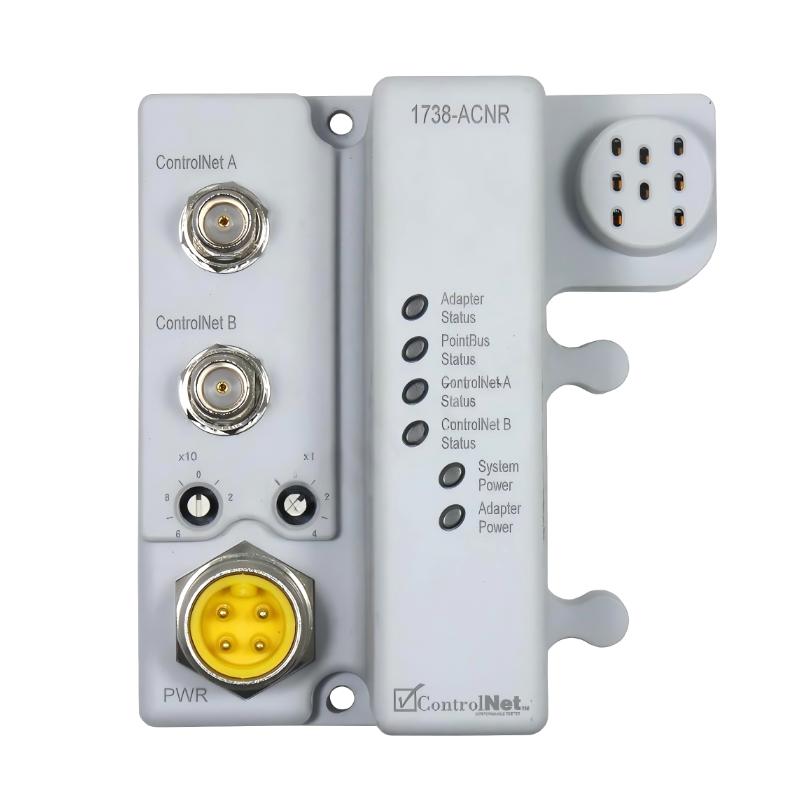
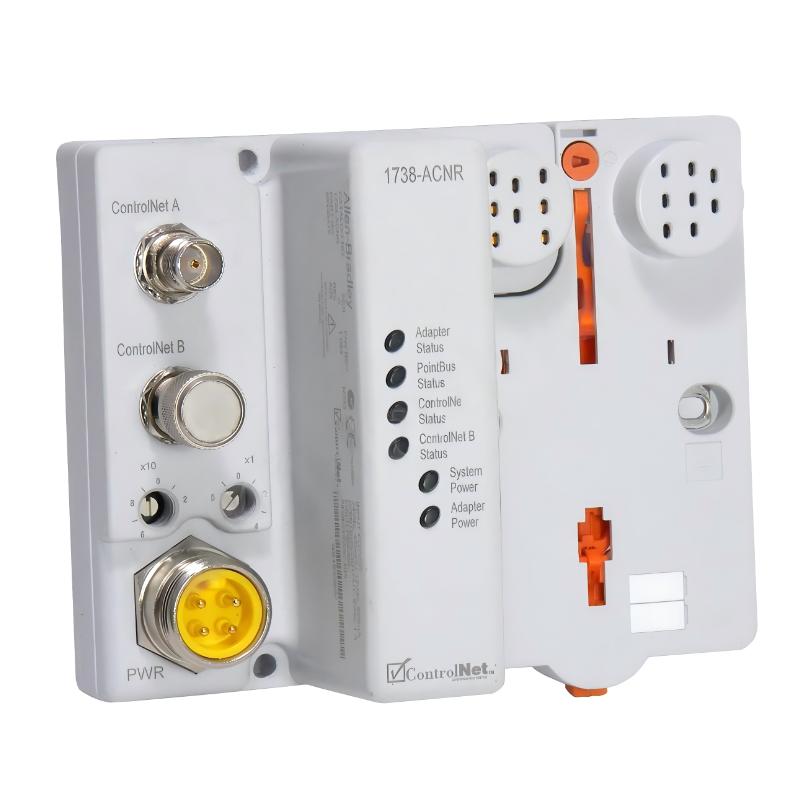
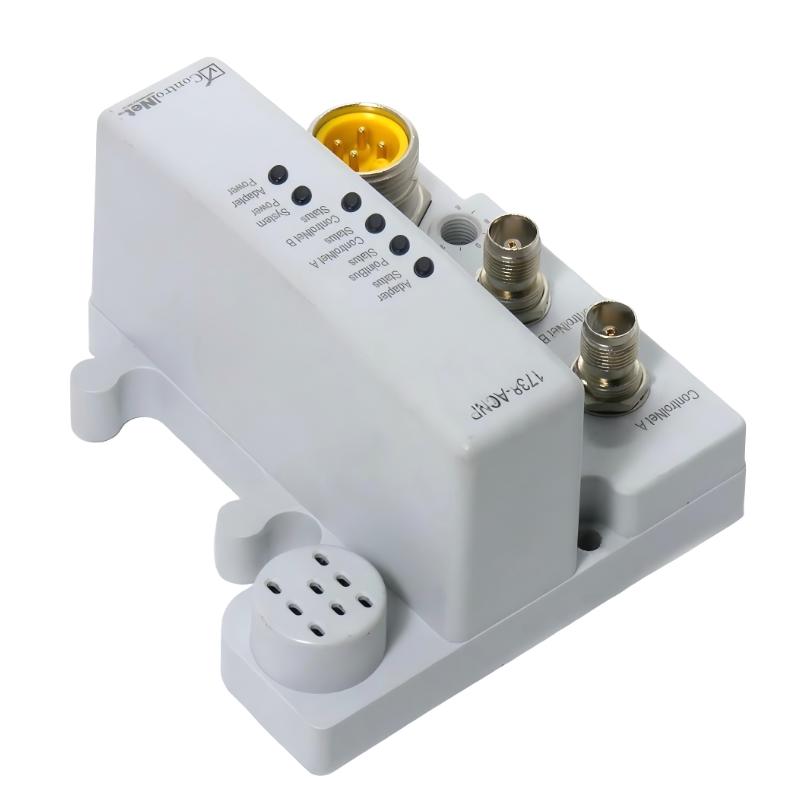
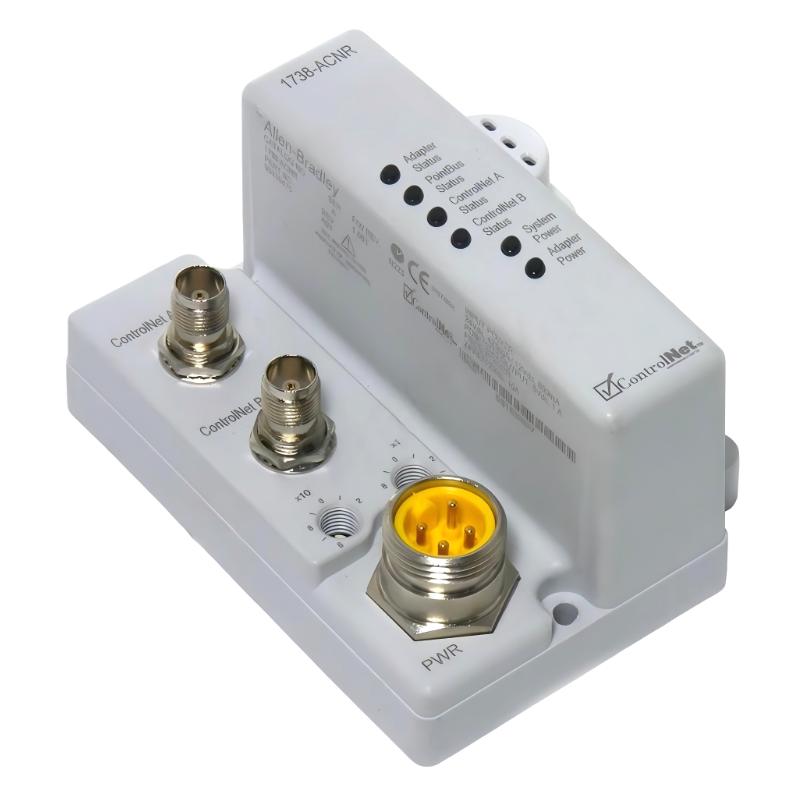
The Allen Bradley 1738-ACNR Network Adapter is a high-reliability ControlNet communication module designed for the ArmorPOINT I/O platform. It serves as the primary network interface between distributed I/O modules and ControlNet-based industrial automation systems, enabling deterministic real-time data exchange in demanding production environments.
Built for on-machine and distributed installations, the 1738-ACNR supports modular I/O expansion while maintaining stable network synchronization and high-speed communication performance. It is widely used in large-scale automation systems where ControlNet topology, redundancy support, and robust field connectivity are required.
With its rugged industrial design, sealed construction options, and support for multiple ArmorPOINT modules, the 1738-ACNR is engineered for continuous operation in harsh environments such as manufacturing plants, process industries, and heavy-duty automation systems.
Technical Specifications
| Parameter | Specification |
|---|
| Manufacturer | Allen Bradley |
| Product Family | ArmorPOINT I/O |
| Model Number | 1738-ACNR |
| Module Type | ControlNet Network Adapter |
| Network Protocol | ControlNet |
| Communication Rate | 5 Mbps |
| Max I/O Capacity | Up to 63 modules per adapter |
| Connection Types | Coax / TNC connector |
| Supply Voltage | 24V DC (10–28.8V DC range) |
| Field Power Current | Approx. 425 mA |
| Power Consumption | ~8 W |
| Power Dissipation | ~2.8 W |
| Backplane Current | Up to 1.0 A |
| Redundancy Support | Yes (ControlNet redundant architecture capable) |
| Mounting Type | On-machine / DIN rail / sealed enclosure system |
| Enclosure Rating | IP65 / IP66 / IP67 / IP69K (system dependent) |
| Operating Temperature | -20°C to 60°C |
| Dimensions | Approx. 112 mm × 72 mm × 65 mm |
| Weight | Approx. 1.0–1.2 kg |
Industrial Applications
The 1738-ACNR is widely deployed in distributed automation systems requiring deterministic communication and high system availability.
Typical applications include:
-
Large-scale manufacturing automation systems
-
Automotive production lines
-
Process control systems (chemical, oil & gas, utilities)
-
Heavy machinery control networks
-
Packaging and high-speed production lines
-
Distributed on-machine I/O architectures
-
Factory-wide ControlNet communication systems
-
Redundant industrial control networks
Its ability to support many I/O modules under a single network node makes it suitable for complex industrial control topologies.
Product Advantages
Deterministic High-Speed Communication
ControlNet protocol provides predictable 5 Mbps cyclic communication, ideal for time-critical industrial control systems.
High I/O Expansion Capacity
Supports up to 63 ArmorPOINT modules, enabling scalable distributed automation architectures.
Rugged Industrial Design
Sealed construction options allow reliable operation in harsh environments including dust, vibration, and moisture exposure.
Flexible System Integration
Works as a central communication hub between field I/O and ControlLogix-based controllers.
Redundancy-Ready Architecture
Supports redundant network configurations for improved system availability in critical operations.
On-Machine Deployment Capability
Designed for direct machine mounting, reducing cabinet wiring complexity and installation time.
Technical FAQs
1. What is the main function of the 1738-ACNR?
It acts as a ControlNet network adapter for ArmorPOINT distributed I/O systems.
2. What communication protocol does it use?
It uses ControlNet at a fixed 5 Mbps data rate.
3. How many I/O modules can it support?
It can support up to 63 ArmorPOINT I/O modules per network node.
4. What type of connector does it use?
It uses a TNC connector for ControlNet coaxial communication.
5. What is its power supply requirement?
It operates on 24V DC with a typical range of 10–28.8V DC.
6. Can it be used in harsh environments?
Yes. It is designed for sealed, industrial-grade installations with IP65–IP69K protection depending on configuration.
7. What is the typical power consumption?
Around 8 watts under normal operating conditions.
8. Is it suitable for redundant network systems?
Yes. It supports ControlNet redundancy architectures.
9. What industries commonly use it?
Automotive, process industries, manufacturing, packaging, and heavy industrial automation sectors.
10. Is it still widely used today?
It is still used in legacy and installed ControlNet systems, though newer systems often migrate to EtherNet/IP architectures.
 A DCS Q Co., Ltd. - PLC and DCS Industrial Control Equipment Wholesale