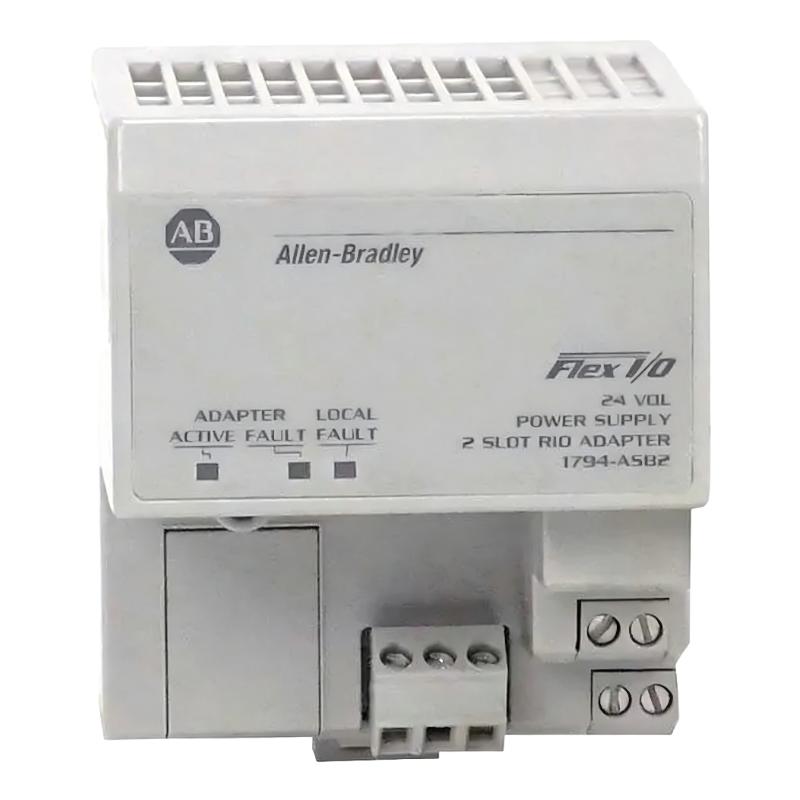
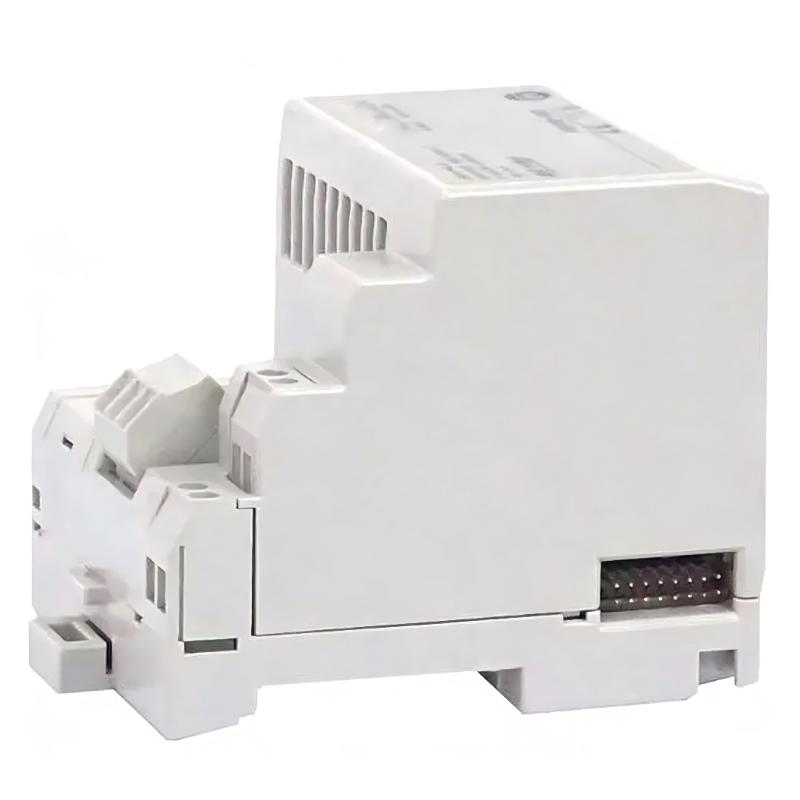
Legacy-Optimized Remote I/O Connectivity for FLEX I/O Systems
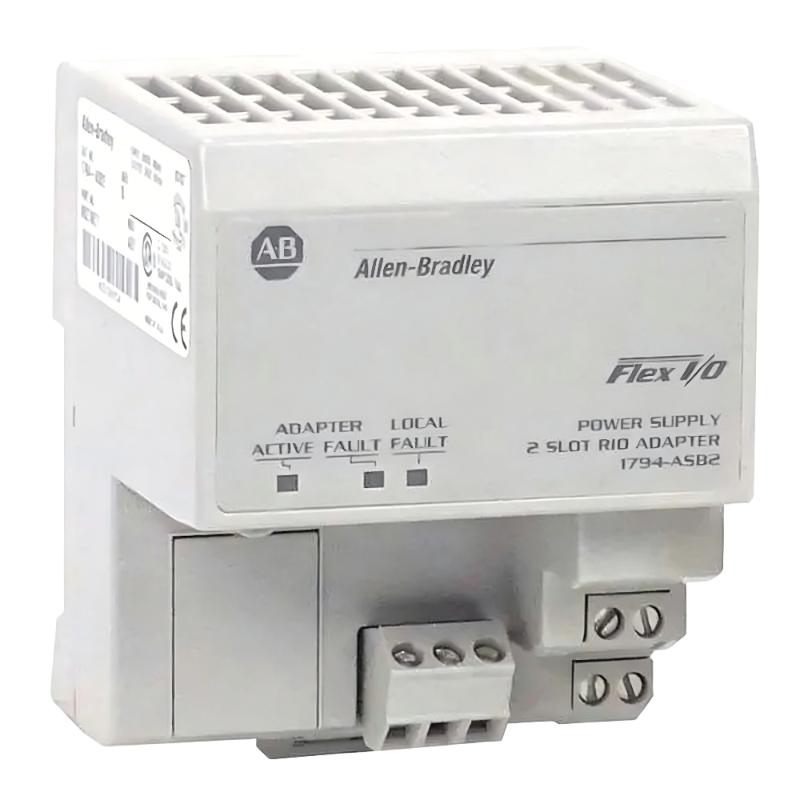
The Allen Bradley 1794-ASB Flex Remote I/O Adapter Module is a proven communication interface designed to connect FLEX I/O racks to legacy Remote I/O (RIO) networks. Built for industrial environments where stable deterministic communication is required, this adapter enables reliable integration between distributed I/O modules and classic PLC-based control systems.
As part of the FLEX I/O family, the 1794-ASB supports compact, modular expansion while maintaining compatibility with established Remote I/O architectures. It remains a widely used solution in legacy modernization projects and industrial systems that prioritize stability, simplicity, and long-term operational continuity.
Technical Specifications & Physical Details
| Specification Item | Details |
|---|
| Product Series | FLEX I/O |
| Module Type | Remote I/O Adapter Module |
| Manufacturer | Allen Bradley |
| Model Number | 1794-ASB |
| Communication Protocol | Remote I/O (RIO) |
| Supported Baud Rates | 57.6 kbps / 115.2 kbps / 230.4 kbps |
| Network Topology | Daisy-chain Remote I/O |
| I/O Capacity | Up to 8 FLEX I/O modules |
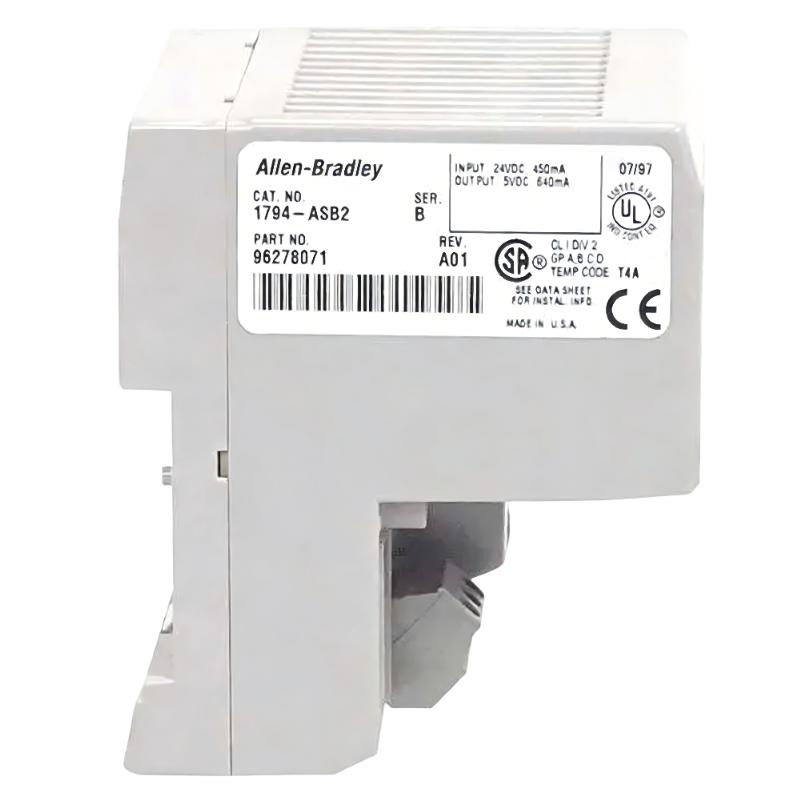
| Input Voltage | 24V DC nominal |
| Voltage Range | 19.2 – 31.2V DC |
| Power Consumption | Approx. 450 mA @ 24V DC |
| Power Dissipation | Approx. 4.6 W |
| FlexBus Output Current | Up to 640 mA |
| Isolation Voltage | ~500 VAC (user power to backplane) |
| Communication Port | 1 x Remote I/O port |
| Mounting Type | DIN Rail / Panel Mount |
| Housing Material | Industrial Thermoplastic |
| Protection Rating | IP20 |
| Operating Temperature | 0°C to 55°C |
| Storage Temperature | -40°C to 85°C |
| Diagnostics | LED status indicators (Power / Fault / Active) |
| Dimensions | Approx. 69 x 68 x 87 mm |
| Weight | Approx. 0.17–0.50 kg |
Industrial Application Areas
The 1794-ASB module is commonly used in industrial systems where Remote I/O networks are still in operation or where legacy PLC systems require continued support.
Typical applications include:
-
Legacy PLC system integration (PLC-5 / SLC platforms)
-
Industrial retrofit and modernization projects
-
Factory automation systems with Remote I/O infrastructure
-
Automotive production lines
-
Packaging machinery control systems
-
Material handling and conveyor networks
-
Process control environments
-
Distributed machine I/O systems
-
Manufacturing equipment upgrades
-
Hybrid legacy-modern control architectures
Key Features & Operational Advantages
Reliable Remote I/O Communication
The module provides stable deterministic communication over Remote I/O networks, ensuring consistent data exchange between controllers and FLEX I/O racks.
Supports Up to 8 FLEX I/O Modules
Allows flexible expansion of distributed I/O configurations while maintaining compact system architecture.
Legacy System Compatibility
Designed specifically for integration with older PLC systems, making it ideal for plant upgrades without full system replacement.
Simplified System Architecture
Reduces wiring complexity by centralizing I/O communication through a single adapter module.
Industrial Durability
Built for continuous operation in harsh industrial environments with strong resistance to vibration and temperature variation.
Compact Modular Design
Saves cabinet space while maintaining full functionality for distributed control applications.
Stable Long-Term Operation
Widely known for dependable performance in long-life industrial installations where reliability is critical.
Technical FAQs
1. What is the primary function of the 1794-ASB module?
It connects FLEX I/O systems to Remote I/O (RIO) networks used in legacy industrial control systems.
2. Which communication protocol does it use?
It uses the Remote I/O (RIO) protocol.
3. How many FLEX I/O modules can it support?
It supports up to 8 FLEX I/O modules per adapter.
4. What is the communication speed range?
It supports 57.6 kbps, 115.2 kbps, and 230.4 kbps.
5. What type of controllers is it commonly used with?
It is commonly used with legacy PLC systems such as PLC-5 and SLC platforms.
6. What voltage does the module require?
It operates on a 24V DC supply within a 19.2–31.2V DC range.
7. Is it suitable for modern Ethernet-based systems?
Not directly; it is mainly used in legacy Remote I/O architectures.
8. Can it be used in modernization projects?
Yes, it is often used in hybrid systems bridging legacy and modern automation.
9. Does it support DIN rail mounting?
Yes, it supports DIN rail and panel mounting configurations.
10. Is the module designed for industrial environments?
Yes, it is built for reliable long-term operation in demanding industrial conditions.
 A DCS Q Co., Ltd. - PLC and DCS Industrial Control Equipment Wholesale