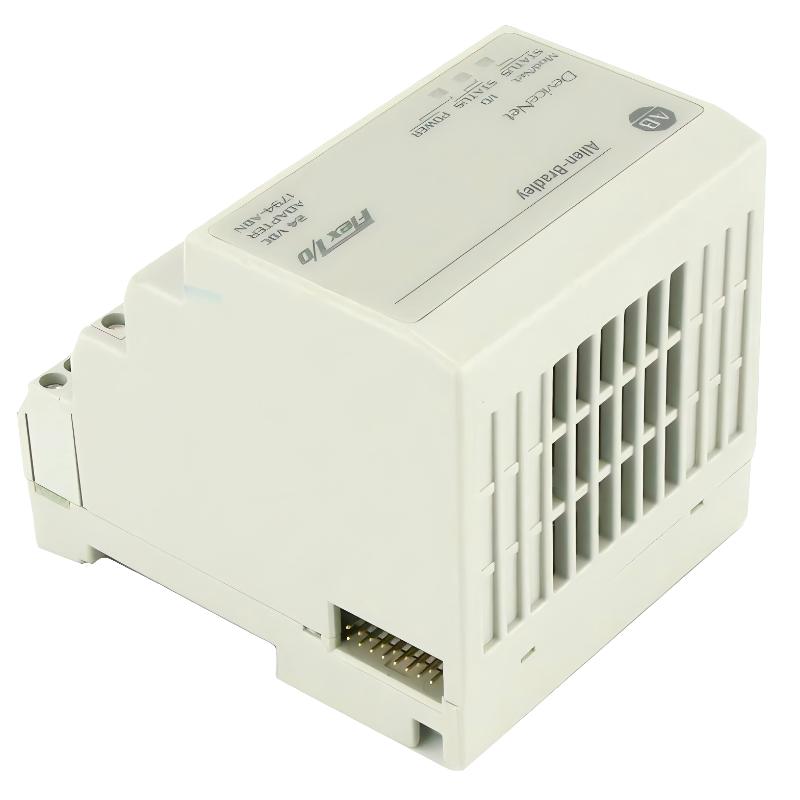
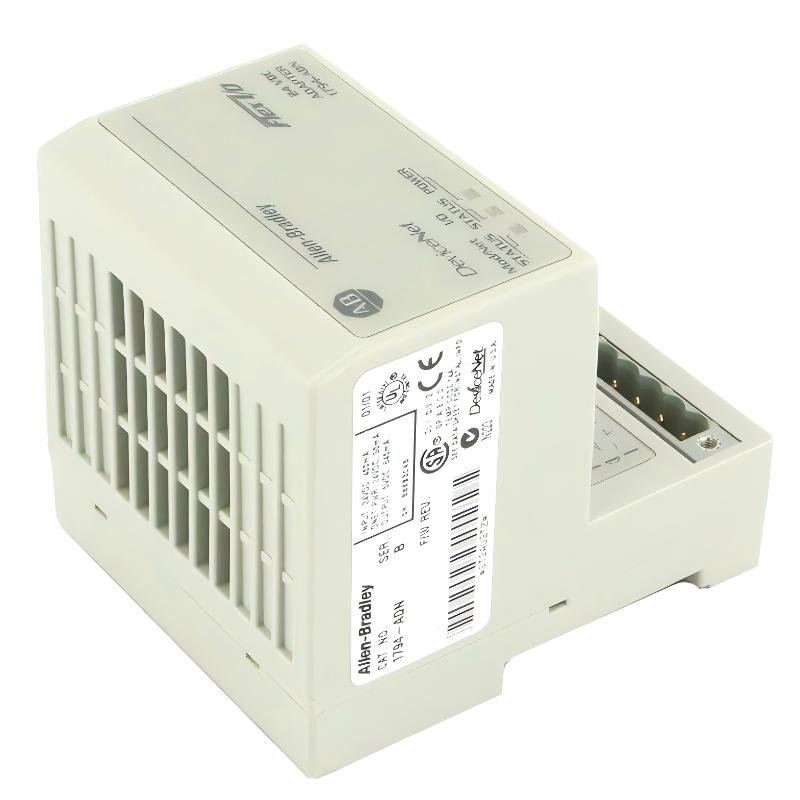
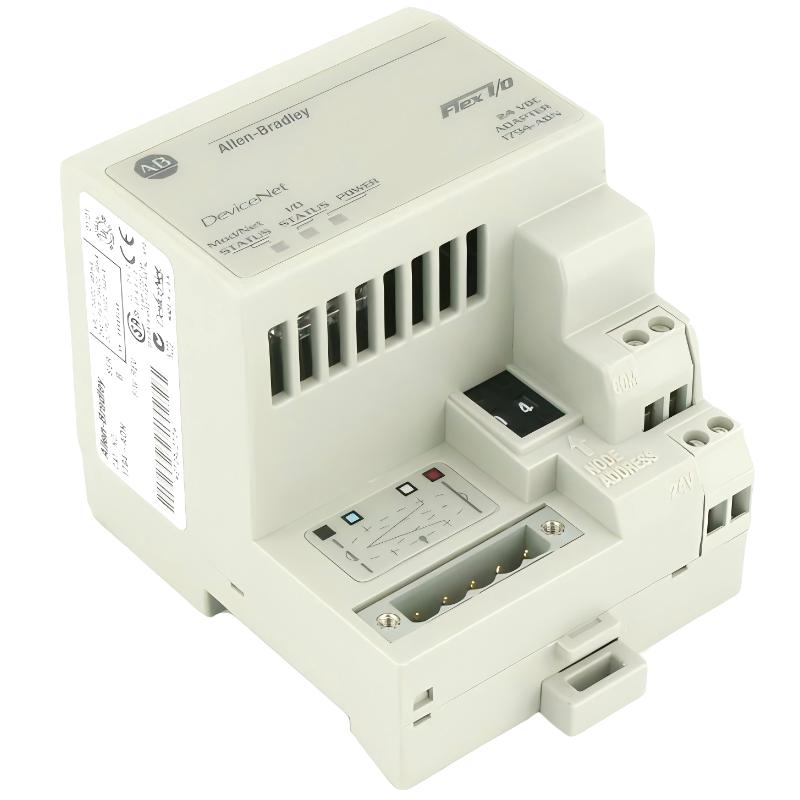
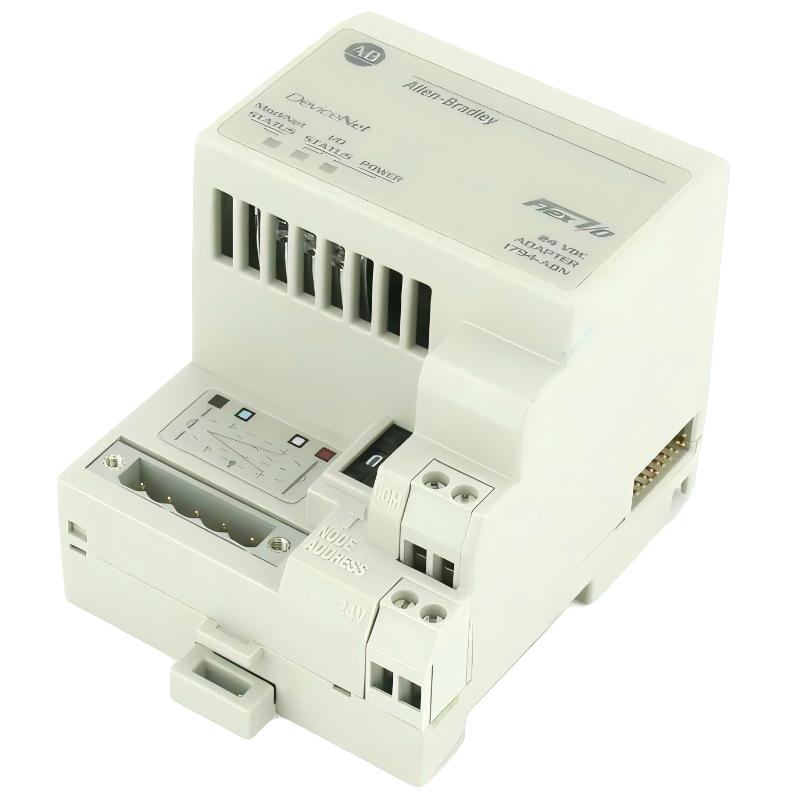
Reliable DeviceNet Connectivity for Distributed FLEX I/O Systems
The Allen Bradley 1794-ADN Flex I/O DeviceNet Adapter Module is designed to provide stable and efficient communication between distributed FLEX I/O modules and DeviceNet-based industrial control networks. As a key interface component in modular automation architectures, it enables seamless data exchange between field devices and PLC systems while supporting flexible system expansion.
Built for industrial environments requiring dependable network performance, the 1794-ADN helps simplify wiring, reduce panel space usage, and improve overall system organization. Its compact and modular design makes it a widely used solution in machine-level distributed I/O applications where reliability and scalability are essential.
Technical Specifications & Physical Characteristics
| Specification | Details |
|---|
| Product Series | FLEX I/O |
| Module Type | DeviceNet Adapter Module |
| Manufacturer | Allen Bradley |
| Model Number | 1794-ADN |
| Communication Protocol | DeviceNet |
| Network Speed Options | 125 kbps / 250 kbps / 500 kbps |
| Supported I/O Capacity | Up to 63 FLEX I/O modules |
| DeviceNet Nodes | 1 node per adapter |
| Input Voltage | 24V DC |
| Voltage Range | 19.2 – 31.2V DC |
| Power Consumption | Low power industrial design |
| Mounting Type | DIN Rail / Panel Mount |
| Enclosure Material | Industrial Thermoplastic |
| Protection Rating | IP20 |
| Operating Temperature | 0°C to 55°C |
| Storage Temperature | -40°C to 85°C |
| Status Indicators | Network & Module LEDs |
| Dimensions | Approx. 87 x 69 x 69 mm |
| Weight | Approx. 0.25 kg |
Industrial Application Areas
The 1794-ADN module is commonly used in distributed automation systems where DeviceNet communication is required for remote I/O control and monitoring.
Typical applications include:
-
Factory automation systems
-
Automotive assembly lines
-
Packaging machinery
-
Conveyor and material handling systems
-
Process control environments
-
Industrial machine monitoring
-
Distributed control cabinets
-
Production line automation
-
Remote I/O expansion systems
-
High-density industrial control networks
Key Features & Performance Advantages
Stable DeviceNet Communication
The module provides reliable and deterministic communication across DeviceNet networks, ensuring consistent data transfer between controllers and field devices.
Flexible FLEX I/O Expansion
Supports up to 63 FLEX I/O modules, enabling scalable system architecture for complex automation requirements.
Compact Modular Design
Its small footprint helps optimize control cabinet space while maintaining high system functionality.
Simplified System Integration
Acts as a bridge between DeviceNet networks and FLEX I/O modules, reducing wiring complexity and improving installation efficiency.
Industrial-Grade Durability
Built for continuous industrial operation, the module ensures long-term reliability in demanding environments.
Efficient Diagnostics
Integrated LED indicators provide quick status feedback for network and module health monitoring.
Scalable Automation Architecture
Ideal for systems requiring future expansion without major redesign of existing infrastructure.
Technical FAQs
1. What is the primary function of the 1794-ADN module?
It serves as a DeviceNet communication adapter for FLEX I/O systems, enabling data exchange between PLCs and distributed I/O modules.
2. Which communication protocol does it support?
The module operates using the DeviceNet industrial communication protocol.
3. How many FLEX I/O modules can it support?
It can support up to 63 FLEX I/O modules in a single system configuration.
4. What voltage does the module require?
It typically operates on a 24V DC power supply with a range of 19.2–31.2V DC.
5. Is the module suitable for distributed systems?
Yes, it is specifically designed for distributed industrial automation architectures.
6. What industries commonly use this module?
It is widely used in manufacturing, automotive, packaging, logistics, and process automation industries.
7. Does it support DIN rail installation?
Yes, it supports both DIN rail and panel mounting options.
8. Is the module still actively supported?
It remains widely used in legacy and existing systems, though lifecycle status may vary by region.
9. Can it reduce wiring complexity?
Yes, it significantly reduces wiring by centralizing communication through the FLEX I/O backplane.
10. Does it include diagnostic indicators?
Yes, LED indicators provide real-time network and module status information.
 A DCS Q Co., Ltd. - PLC and DCS Industrial Control Equipment Wholesale