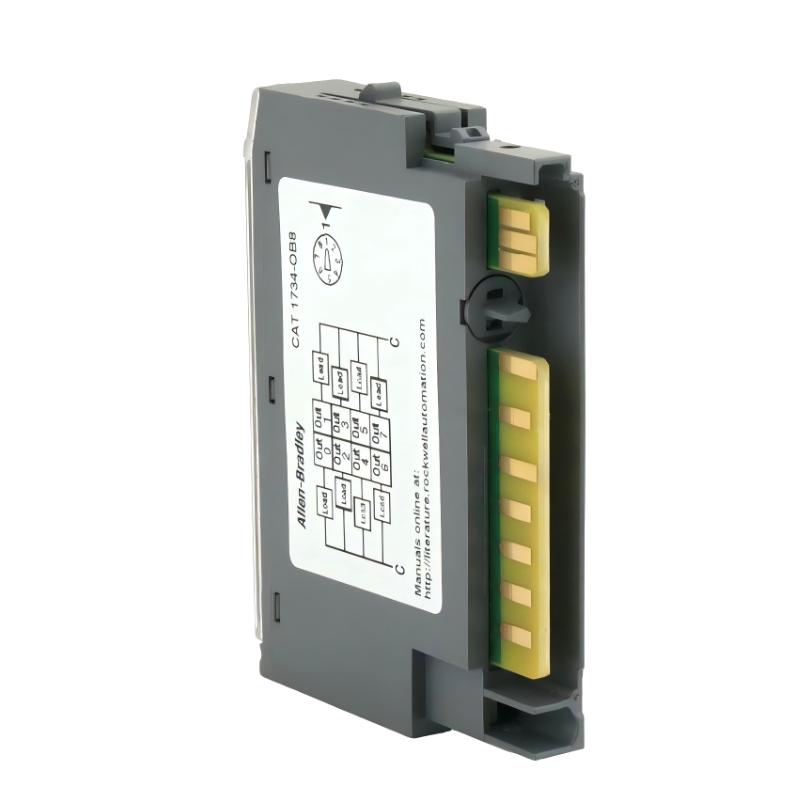
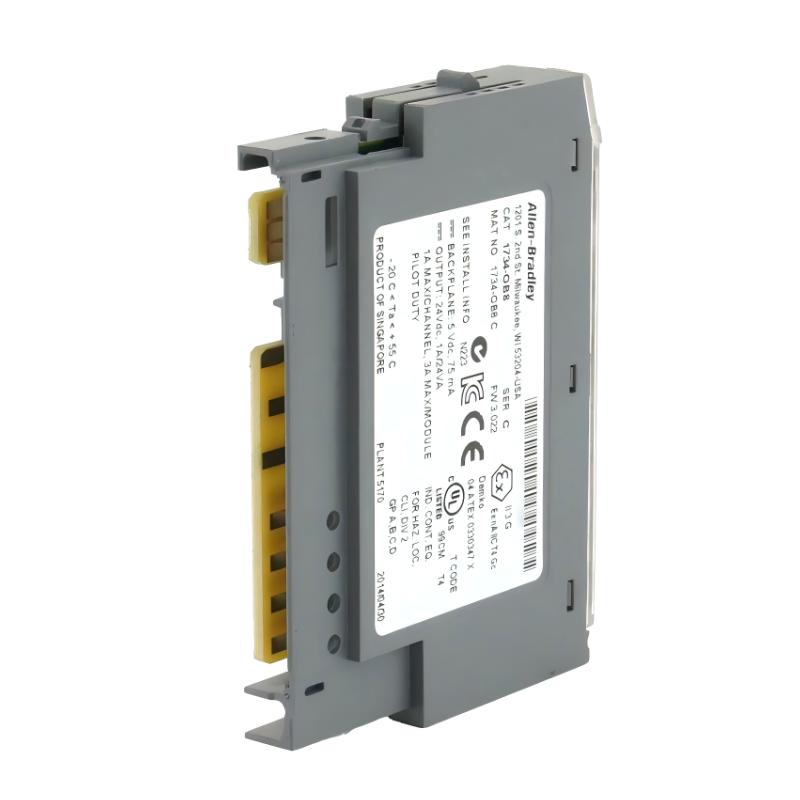
Product Introduction
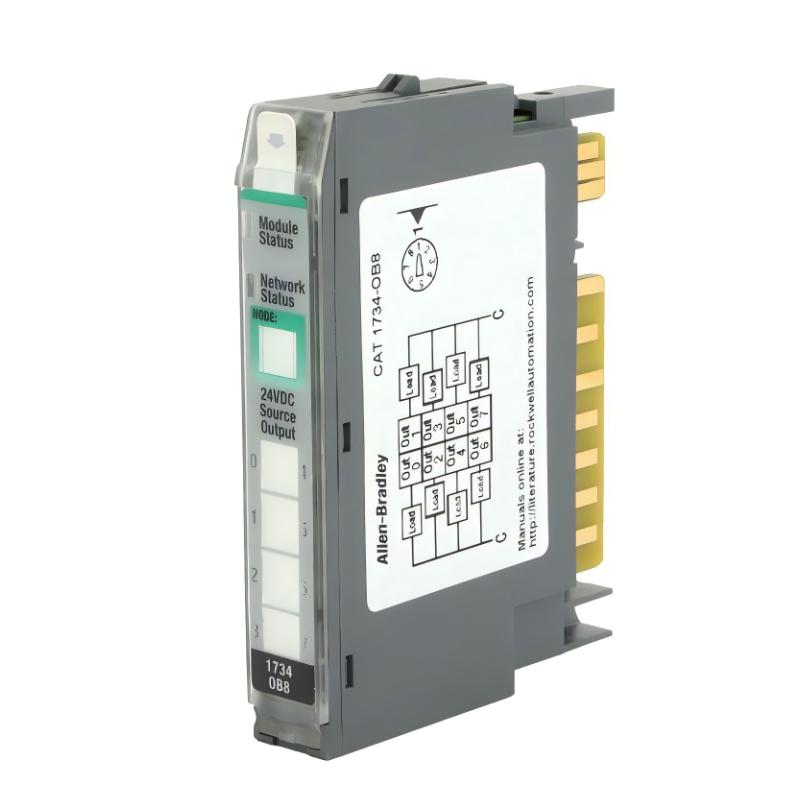
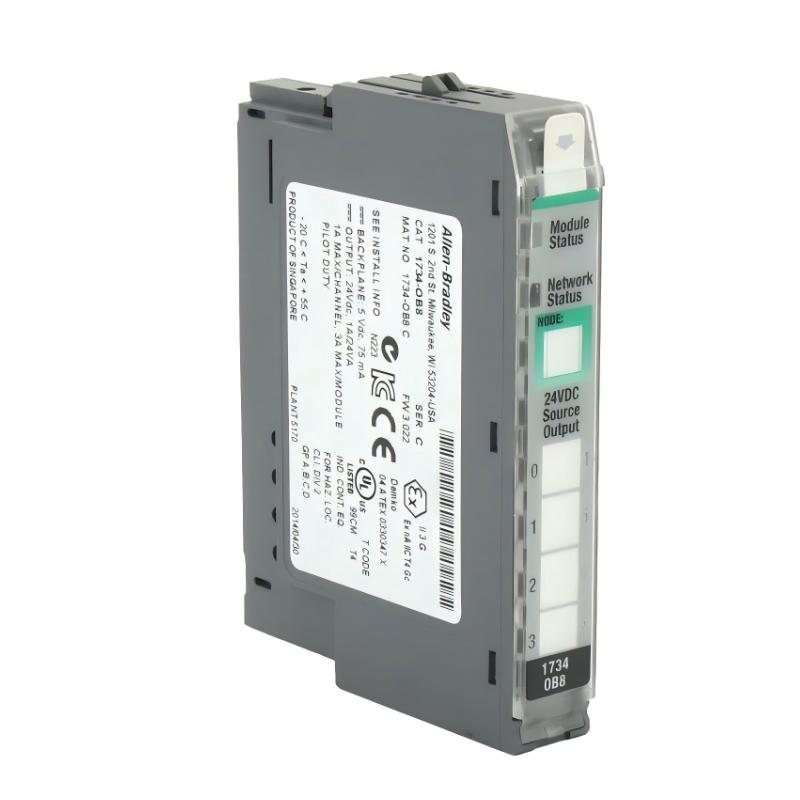
The Allen-Bradley 1734-OB8 Digital Output Module is a discrete output interface designed for the POINT I/O modular automation platform. It allows programmable controllers to send digital control signals to multiple field devices within a distributed automation network.
Its eight-channel configuration provides higher output density compared with smaller modules, allowing engineers to manage more devices within a single I/O station. The module supports efficient machine-level control while maintaining compatibility with modern Logix-based PLC systems.
By combining compact design, modular expansion capability, and dependable output performance, the 1734-OB8 module plays an important role in flexible industrial automation architectures.
Technical Specifications
| Parameter | Specification |
|---|
| Product Model | 1734-OB8 |
| Product Type | Digital Output Module |
| I/O Platform | POINT I/O |
| Number of Outputs | 8 Digital Outputs |
| Output Voltage | 24V DC |
| Output Type | Discrete Output |
| Mounting Method | POINT I/O Base |
| Operating Temperature | 0°C to 55°C |
| Dimensions | 56 × 12 × 75.5 mm |
| Weight | 0.035 kg (0.077 lb) |
Industrial Deployment Context
The Allen-Bradley 1734-OB8 Digital Output Module is part of the POINT I/O distributed control system, designed for machine-level automation where multiple digital outputs are required in a compact form factor. The module enables programmable controllers to switch field devices reliably while supporting decentralized control architecture.
It is frequently implemented in:
-
Automated packaging lines controlling multiple pneumatic actuators
-
Conveyor and sorting systems operating signal indicators and relays
-
Assembly stations requiring distributed control of solenoids and valves
-
Food and beverage machinery with modular remote I/O cabinets
-
Warehouse automation systems integrating distributed digital outputs
Because the module can be installed near production equipment, it helps reduce wiring distances and simplifies installation in modern modular automation environments.
Functional Benefits for System Designers
The module provides several advantages that make it suitable for flexible industrial control system design.
Eight-Channel Output Capacity
With eight discrete outputs, the module can control multiple field devices from a single compact unit, improving I/O density within distributed stations.
Compact POINT I/O Architecture
The slim design allows engineers to install numerous modules in limited cabinet space while maintaining organized system layouts.
Efficient Distributed Control
Locating I/O modules close to field devices reduces wiring complexity and improves maintenance accessibility.
Seamless Integration with Logix Controllers
Through POINT I/O communication adapters, the module communicates effectively with CompactLogix and ControlLogix automation systems.
Industrial-Grade Operational Stability
The module is engineered to operate reliably in demanding industrial environments with continuous operation cycles.
Technical FAQs
1. How many outputs are available on the 1734-OB8 module?
The module provides eight discrete digital output channels.
2. What type of devices are typically controlled by this module?
Common devices include relays, solenoid valves, signal lights, and contactors.
3. What output voltage level is supported?
The outputs operate at 24V DC, which is standard for industrial discrete control circuits.
4. How does the module communicate with the PLC?
It connects through a POINT I/O communication adapter that links the I/O station to a controller via industrial networks such as EtherNet/IP.
5. Is the module compatible with ControlLogix controllers?
Yes. Through POINT I/O adapters, it integrates with both ControlLogix and CompactLogix systems.
6. Does the module support diagnostic feedback?
Yes. Output status and diagnostic information can be transmitted to the PLC for monitoring.
7. Can the outputs drive inductive loads?
Yes, but suppression components such as diodes or surge protectors are recommended for inductive devices.
8. Is the module suitable for machine-mounted I/O stations?
Yes. Its compact size and modular design make it ideal for decentralized I/O installations.
9. Can the module be expanded with additional POINT I/O modules?
Yes. The POINT I/O architecture allows additional modules to be added for expanded functionality.
10. How does distributed I/O improve automation system design?
Distributed I/O reduces cable routing, simplifies installation, and improves maintenance efficiency.
 A DCS Q Co., Ltd. - PLC and DCS Industrial Control Equipment Wholesale