 Introduction
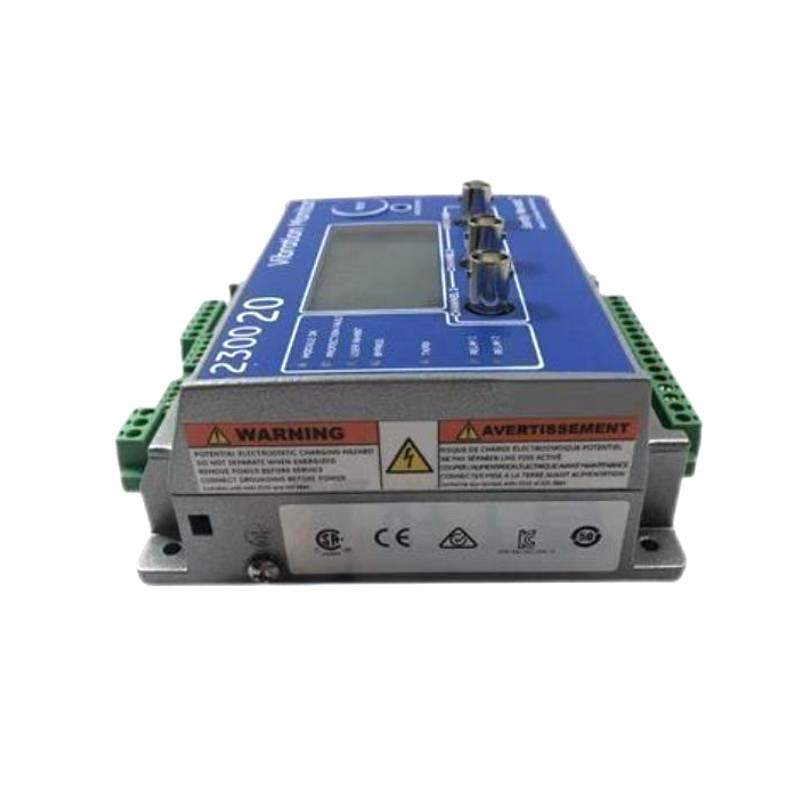
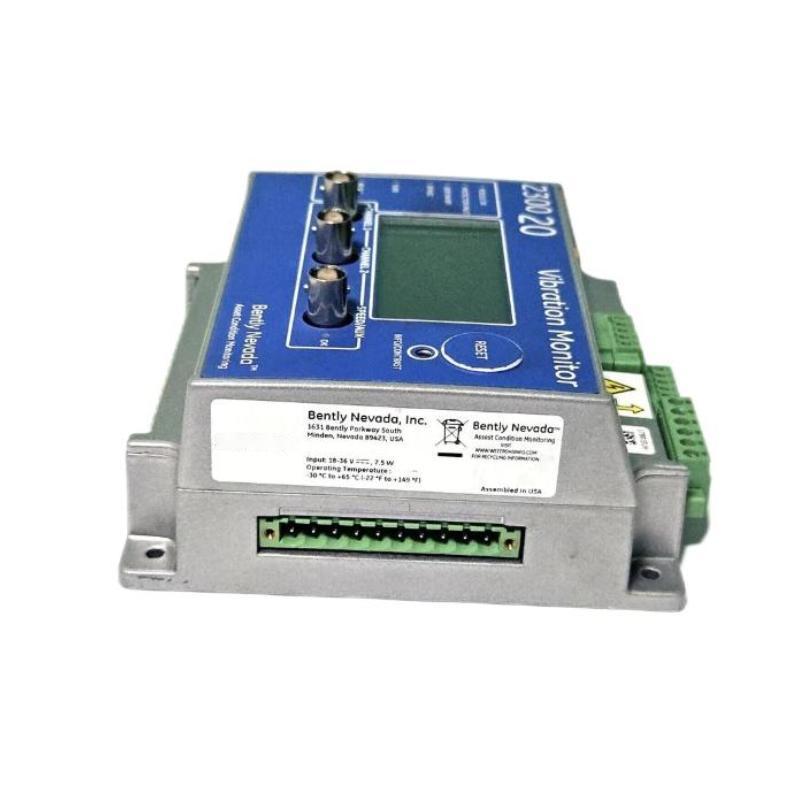
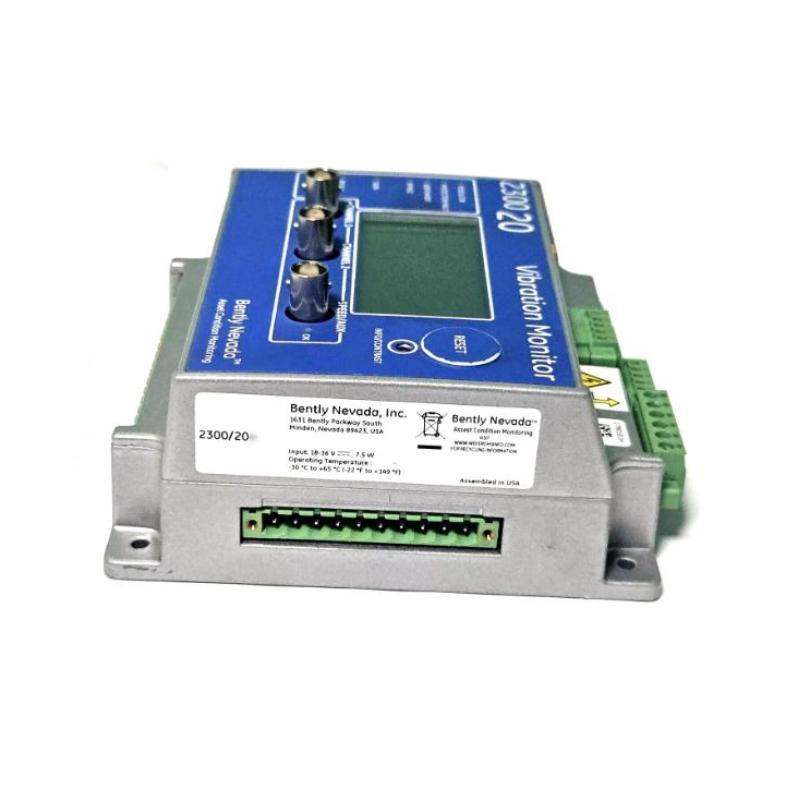
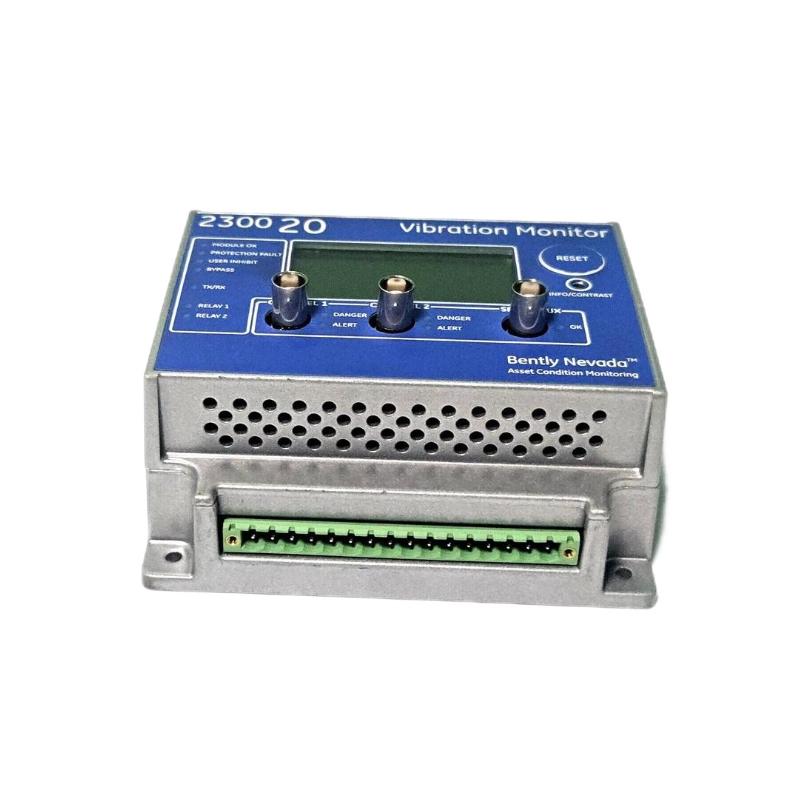
The Bently Nevada 2300/20-CN is a compact vibration monitor designed to provide continuous machinery condition monitoring and protection for low- to medium-critical rotating equipment. Unlike a standalone vibration sensor, the 2300/20-CN combines signal processing, alarm logic, local indication, communication capability, and industrial outputs in a single monitoring platform.
The CN configuration provides 4–20 mA outputs, making the monitor particularly useful for plants that need to integrate vibration information into an existing PLC, DCS, SCADA, or plant control architecture. It accepts a wide range of vibration inputs and provides configurable measurement functions for practical machine-health monitoring.
With 18–36 VDC power input, Ethernet connectivity, configurable bandpass filtering, relay outputs, and buffered signal outputs, the 2300/20-CN offers a flexible solution for applications where full-scale machinery protection infrastructure may be unnecessary but continuous vibration information is still important.
Its compact 127 × 127 × 76.2 mm enclosure and approximately 1.03 kg unit weight also make it well suited to panel-mounted or DIN-rail installations where cabinet space matters.
Technical Specifications
The 2300/20-CN is part of the Bently Nevada 2300 Series vibration-monitoring platform. Its design supports continuous vibration measurement, alarm handling, speed-related measurements, and communication with higher-level condition-monitoring systems.
| Specification | Details |
|---|
| Manufacturer | Bently Nevada |
| Model Number | 2300/20-CN |
| Product Type | Vibration Monitor |
| Series | 2300 Series |
| Configuration | CN |
| Output Type | 4–20 mA analog outputs |
| Power Input | 18–36 VDC |
| Maximum Power Consumption | Approximately 7.5 W |
| Operating Temperature | -30°C to +65°C / -22°F to +149°F |
| Storage Temperature | -40°C to +85°C / -40°F to +185°F |
| Relative Humidity | Up to 95%, non-condensing |
| Bandpass Filter | Configurable, approximately 0.2 Hz to 20 kHz |
| Accelerometer Scale Factor | Approximately 5–1000 mV/g |
| Full-Scale Range | Approximately 2–80 g peak |
| Sensor Current | Approximately 3.3 mA ±5% |
| Ethernet | 10Base-T / 100Base-TX |
| Ethernet Connector | RJ-45 |
| Maximum Ethernet Cable Length | Up to 100 m / 328 ft |
| Buffered Outputs | 3 BNC outputs |
| Relay Function | Alarm / machinery status monitoring |
| Mounting | Panel mount or DIN rail with adapter |
| Dimensions | 127 × 127 × 76.2 mm |
| Dimensions in Inches | 5 × 5 × 3 in |
| Unit Weight | Approximately 1.03 kg / 2.26 lb |
| Shipping Weight | Approximately 2 kg |
| Typical Application | Continuous vibration monitoring and machinery protection |
Applications
Continuous Rotating Machinery Monitoring
The 2300/20-CN is designed for continuous monitoring of rotating machinery where vibration trends can provide an early indication of changing operating conditions.
It can be applied to equipment such as pumps, motors, fans, compressors, blowers, and other balance-of-plant machinery.
Pump and Motor Protection
For critical pumps and motors that do not require a large centralized machinery protection rack, the 2300/20-CN offers a compact monitoring alternative. Vibration values can be transmitted through analog outputs while alarm conditions can be handled locally.
Compressor Monitoring
Compressors can experience vibration changes associated with imbalance, misalignment, bearing deterioration, looseness, or other mechanical conditions. Continuous monitoring gives maintenance personnel a more useful picture than occasional handheld measurements.
Fan and Blower Applications
Industrial fans and blowers are often numerous within a facility, making compact monitoring equipment attractive. The 2300/20-CN can provide dedicated monitoring while maintaining integration with existing control systems.
Auxiliary Turbomachinery
The monitor can also be applied to selected auxiliary rotating equipment associated with larger turbine and power-generation systems, especially where a distributed monitoring architecture is preferred.
Process Plant Condition Monitoring
The 4–20 mA outputs make the monitor especially useful in plants where vibration values need to be displayed alongside pressure, temperature, flow, and other process variables within an existing control system.
Remote Machinery Monitoring
Ethernet connectivity allows monitoring data to be integrated into a broader condition-monitoring environment. This is useful for plants seeking centralized visibility without installing a large monitoring rack at every machine.
Advantages
Integrated Vibration Monitoring
The 2300/20-CN combines measurement, processing, alarm functions, and communication in one compact unit. This reduces the need to assemble a monitoring channel from multiple separate devices.
4–20 mA Plant Integration
Its 4–20 mA outputs make it particularly attractive for conventional industrial automation environments. Vibration information can be brought into PLC or DCS systems using a familiar analog signal format.
Ethernet Connectivity
The Ethernet interface provides a modern communication path for transferring monitoring information and connecting the device with condition-monitoring software.
Compact Industrial Footprint
Measuring only 127 × 127 × 76.2 mm, the monitor occupies relatively little cabinet space while still providing multiple monitoring functions.
Flexible Installation
The monitor supports panel mounting or DIN-rail mounting with an adapter, giving system designers greater freedom when laying out control cabinets and local monitoring panels.
Wide Input Range
The configurable measurement architecture supports different vibration signal conditions and allows the monitoring channel to be adapted to the selected sensor and application.
Configurable Filtering
A configurable bandpass range extending from approximately 0.2 Hz to 20 kHz provides flexibility when focusing measurement on the frequency characteristics most relevant to the machine being monitored.
Local Machine Status
Local indicators and display functions allow operators and maintenance personnel to check machine speed, vibration values, setpoints, and monitor status without depending entirely on a remote control system.
Data Capture During Network Disruptions
The 2300 platform can retain alarm-related data captures during a temporary communication interruption, helping preserve useful machinery information for subsequent analysis.
Cost-Effective Distributed Monitoring
For low- to medium-critical machinery, a compact standalone monitor can provide an attractive balance between monitoring capability and system complexity.
Technical FAQs
1. What is the Bently Nevada 2300/20-CN?
The 2300/20-CN is a Bently Nevada 2300 Series vibration monitor designed for continuous vibration monitoring and machinery protection. The CN configuration provides 4–20 mA outputs for integration with plant automation systems.
2. What power supply does the 2300/20-CN require?
The monitor operates from an 18–36 VDC power supply. Maximum power consumption is approximately 7.5 W, depending on operating conditions and connected functions.
3. Does the 2300/20-CN provide 4–20 mA outputs?
Yes. The CN version is specifically configured with 4–20 mA outputs, allowing vibration measurements to be integrated into PLC, DCS, SCADA, or other analog-input systems.
4. What type of sensors can the 2300/20 monitor?
The 2300 platform is designed to work with vibration sensors such as compatible ICP accelerometers, with configurable input characteristics to accommodate different sensor sensitivities and measurement requirements.
5. Does the monitor support Ethernet communication?
Yes. The 2300 Series provides 10Base-T and 100Base-TX Ethernet through an RJ-45 interface. The specified maximum Ethernet cable length is approximately 100 meters (328 feet).
6. What is the operating temperature range?
The specified operating temperature range is approximately -30°C to +65°C (-22°F to +149°F). Storage temperature is approximately -40°C to +85°C (-40°F to +185°F).
7. What are the dimensions of the 2300/20-CN?
The monitor measures approximately 127 × 127 × 76.2 mm, equivalent to 5 × 5 × 3 inches. This compact form factor supports both panel and DIN-rail installation arrangements.
8. How much does the 2300/20-CN weigh?
The listed unit weight is approximately 1.03 kg (2.26 lb). Shipping weight is commonly listed at approximately 2 kg, depending on packaging and accessories.
9. Can the 2300/20-CN connect to a PLC or DCS?
Yes. Its 4–20 mA outputs and relay functions make it suitable for integration with conventional plant control and protection systems. Ethernet communication can also provide a path to higher-level condition-monitoring software.
10. What is the difference between 2300/20-CN and a standard 2300/20 configuration?
The key distinction is the CN configuration and its 4–20 mA output capability. The exact ordering configuration should be checked when replacing a unit because output, approval, communication, and system-integration requirements can vary between versions.
 A DCS Q Co., Ltd. - PLC and DCS Industrial Control Equipment Wholesale