Applications
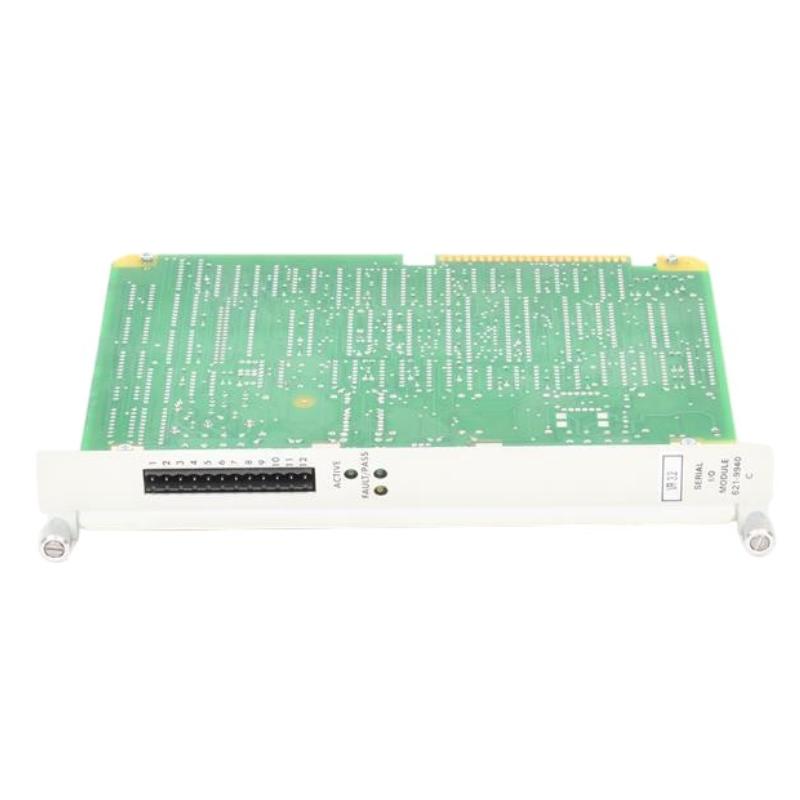
The 621-9940C Serial I/O Module is widely used across automation sectors that rely on serial device integration and legacy device support. Common applications include:
-
Connecting serial field instruments to Honeywell controllers
-
Integrating legacy equipment into modern automation networks
-
Linking process analyzers, bar code scanners, and HMIs to control systems
-
Facilitating communication in SCADA and monitoring applications
-
Supporting test, diagnostic, and maintenance tools via serial interfaces
This module is particularly valuable in environments where mixed communication protocols coexist and where Ethernet or bus-based connectivity is not suitable.
Advantages
-
Versatile serial connectivity for field and legacy devices
-
Industrial-grade construction ensures reliable performance in control cabinets
-
Seamless integration with Honeywell control architectures
-
Compact form factor optimizes cabinet space usage
-
Simplified configuration through system tools
These strengths make the 621-9940C a practical choice for system integrators and automation engineers who need dependable serial communication in complex control environments.
Technical FAQs
-
What does the 621-9940C module do?
It provides serial communication interfaces between controllers and external devices.
-
Which systems can this module work with?
It integrates with compatible Honeywell control and automation systems.
-
What types of devices can connect via this module?
Serial field instruments, analyzers, HMIs, and legacy devices with standard serial ports.
-
Is this module suitable for industrial use?
Yes, it is rated for standard industrial control cabinet environments.
-
What communication protocols are supported?
Standard industrial serial protocols, with specific support defined by system configuration.
-
How is it mounted?
It mounts within a Honeywell control rack or system chassis.
-
Does it support multiple baud rates?
Yes, it supports system-defined serial baud rates appropriate to the application.
-
Can it be replaced in the field?
Yes, the module is designed for service replacement within system racks.
-
Does the module require external power?
It uses power supplied by the host control system.
-
Is special configuration software required?
Configuration is typically handled through the host system’s engineering tools.
 A DCS Q Co., Ltd. - PLC and DCS Industrial Control Equipment Wholesale