Product Introduction
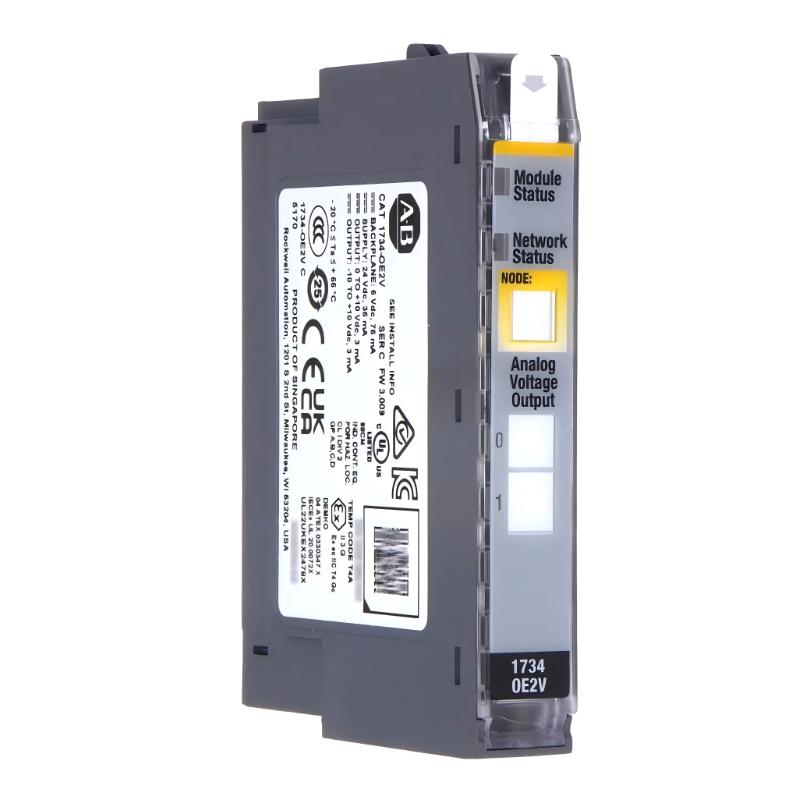
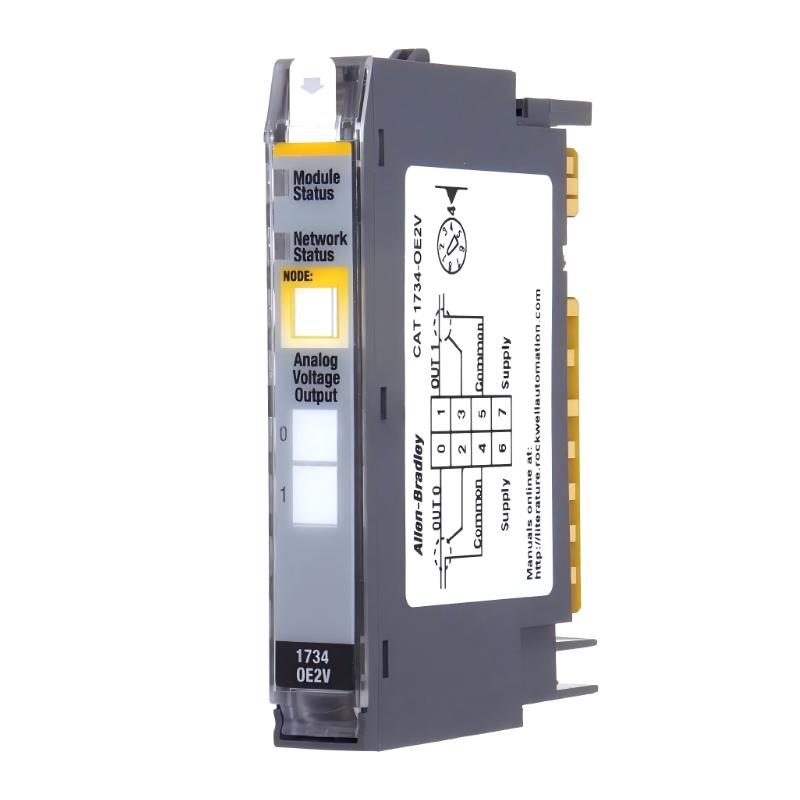
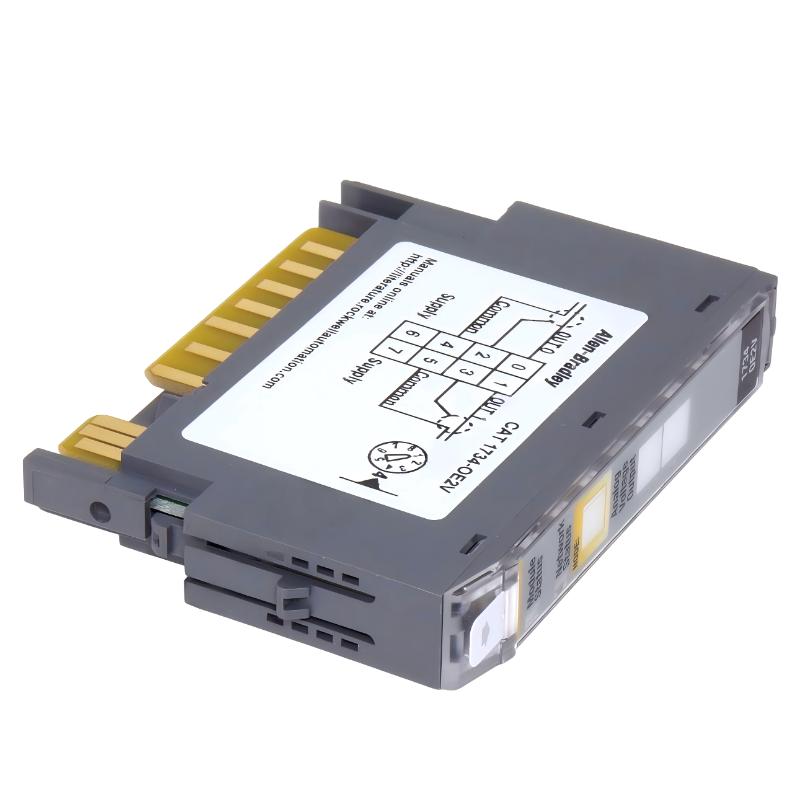
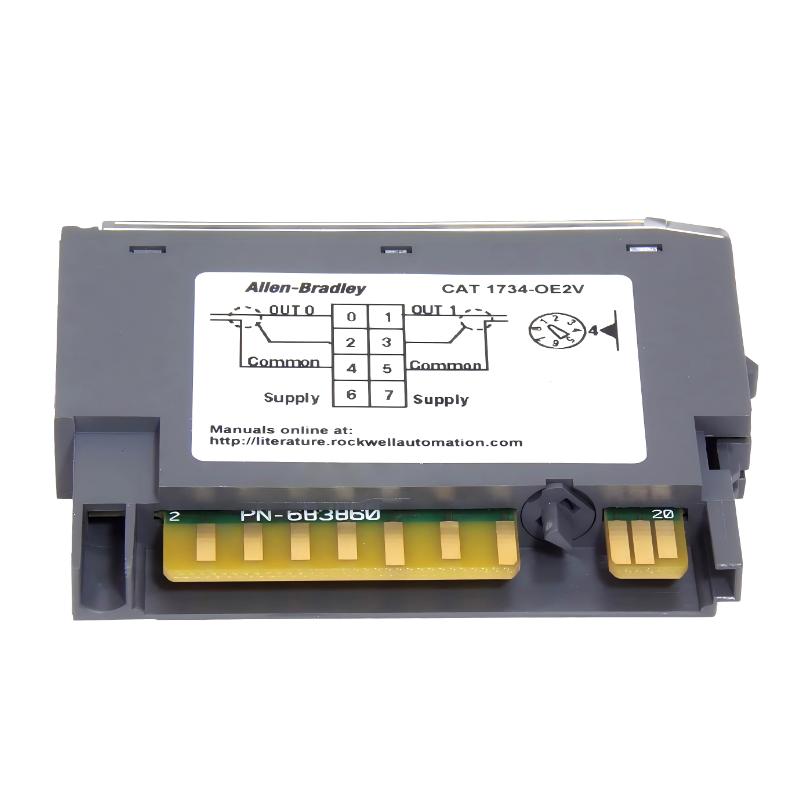
The Allen-Bradley 1734-OE2V Analog Output Module is a compact voltage output interface designed for the POINT I/O distributed automation system. It enables controllers to send continuous voltage signals that regulate industrial processes and machine operations.
Analog output modules play a critical role in automation systems where precise process adjustment is required. By enabling voltage-based control signals, this module allows equipment such as drives, actuators, and valves to operate with accurate control inputs.
Because of its compact size, flexible system integration, and reliable analog signal performance, the 1734-OE2V module is widely used in distributed machine control and process automation systems.
Technical Specifications
| Parameter | Specification |
|---|
| Product Model | 1734-OE2V |
| Product Type | Analog Output Module |
| I/O Platform | POINT I/O |
| Number of Outputs | 2 Analog Voltage Outputs |
| Output Signal Type | Voltage Analog Output |
| Output Range | Configurable Voltage Range |
| Mounting Method | POINT I/O Base |
| Operating Temperature | 0°C to 55°C |
| Dimensions | 56 × 12 × 75.5 mm |
| Weight | 0.036 kg (0.079 lb) |
Common Industrial Integration Scenarios
The Allen-Bradley 1734-OE2V Analog Output Module is designed for distributed automation systems that require accurate voltage-based analog signal output. As part of the POINT I/O platform, the module enables programmable controllers to regulate external equipment by sending continuous voltage signals.
It is commonly implemented in industrial environments where precise analog control is necessary for maintaining process stability and machine performance.
Typical use cases include:
-
Industrial machines controlling servo drives and variable speed drives
-
Process automation systems regulating flow, pressure, or temperature
-
Automated packaging equipment requiring voltage-based actuator control
-
Water and wastewater treatment facilities adjusting pump and valve operation
-
Manufacturing systems using analog control signals for positioning devices
The module’s compact structure makes it ideal for machine-mounted I/O stations or decentralized control panels where space efficiency and system flexibility are priorities.
Engineering Advantages
The module provides a range of features that support precise analog control in distributed industrial systems.
Dedicated Voltage Output Channels
The module delivers stable voltage-based analog signals that are ideal for controlling equipment requiring precise voltage reference inputs.
Compact POINT I/O Form Factor
Its narrow housing allows engineers to install multiple modules in small control cabinets without compromising accessibility.
Improved Signal Quality in Distributed Systems
By placing the module closer to field devices, signal transmission distances are reduced, helping minimize electrical noise interference.
Flexible Automation Architecture
The module integrates seamlessly with POINT I/O communication adapters, enabling connection to modern PLC platforms.
Reliable Industrial Operation
Built with industrial-grade electronics, the module maintains stable analog signal output in demanding manufacturing environments.
Technical FAQs
1. How many output channels are available on the 1734-OE2V module?
The module provides two independent analog voltage output channels.
2. What type of signal output does this module generate?
It generates voltage-based analog signals typically used for industrial process control.
3. Which devices can be controlled using this module?
Typical devices include variable frequency drives, valve positioners, and analog-controlled actuators.
4. How is the module integrated into an automation system?
It operates within a POINT I/O station connected to a PLC through a communication adapter.
5. Is the module compatible with Logix-based controllers?
Yes. It works with CompactLogix and ControlLogix controllers through POINT I/O network adapters.
6. Can the module be used in distributed automation architectures?
Yes. The POINT I/O platform is specifically designed for decentralized I/O installations.
7. Does the module support output signal configuration?
Yes. Output scaling and signal ranges can be configured through the control system programming environment.
8. Can it control speed references for variable speed drives?
Yes. Voltage signals generated by the module can be used as speed reference inputs for drives.
9. Is diagnostic monitoring available?
Yes. Status and diagnostic data can be communicated back to the controller.
10. How does the module maintain signal stability in industrial environments?
The design includes noise-resistant circuitry and reliable electrical isolation to ensure stable analog output performance.
 A DCS Q Co., Ltd. - PLC and DCS Industrial Control Equipment Wholesale