Product Introduction
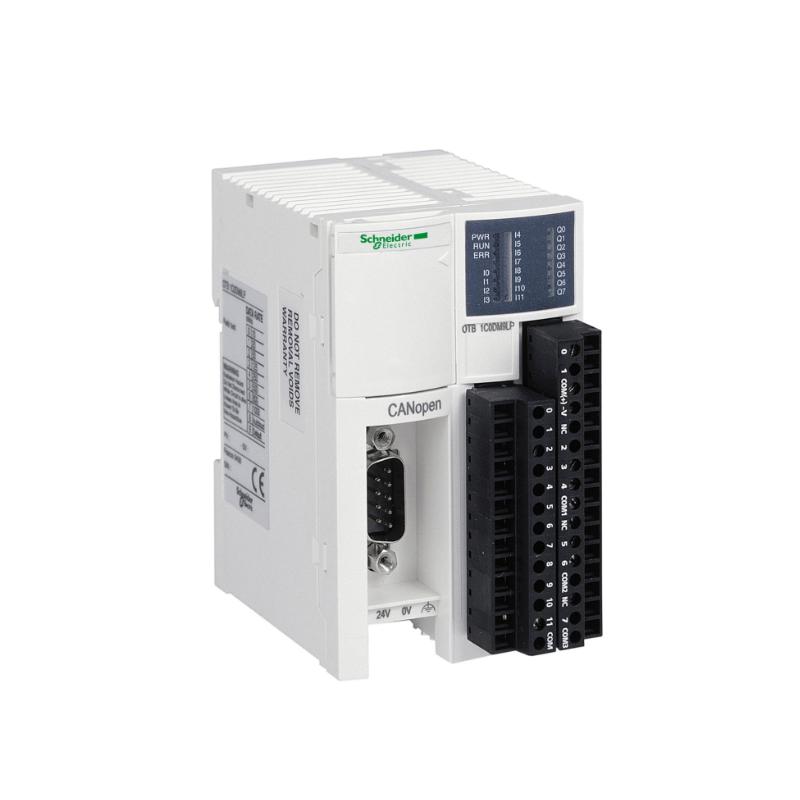
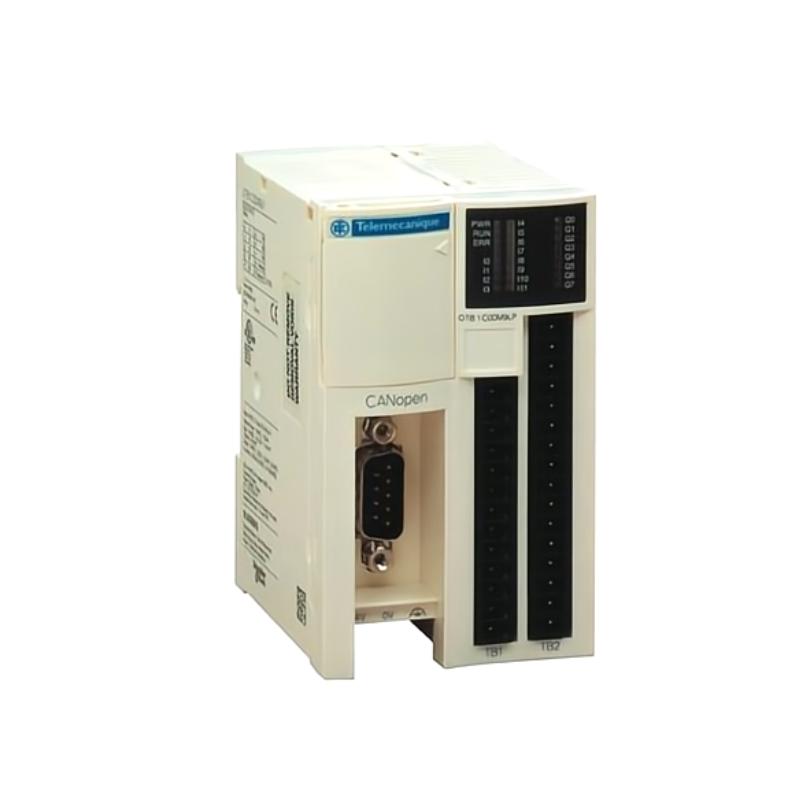
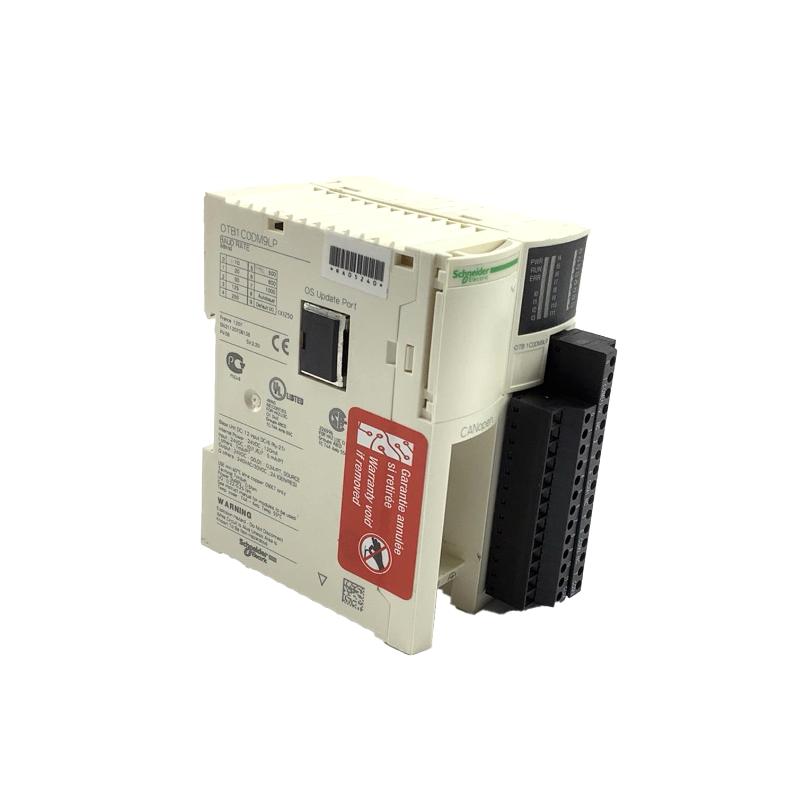
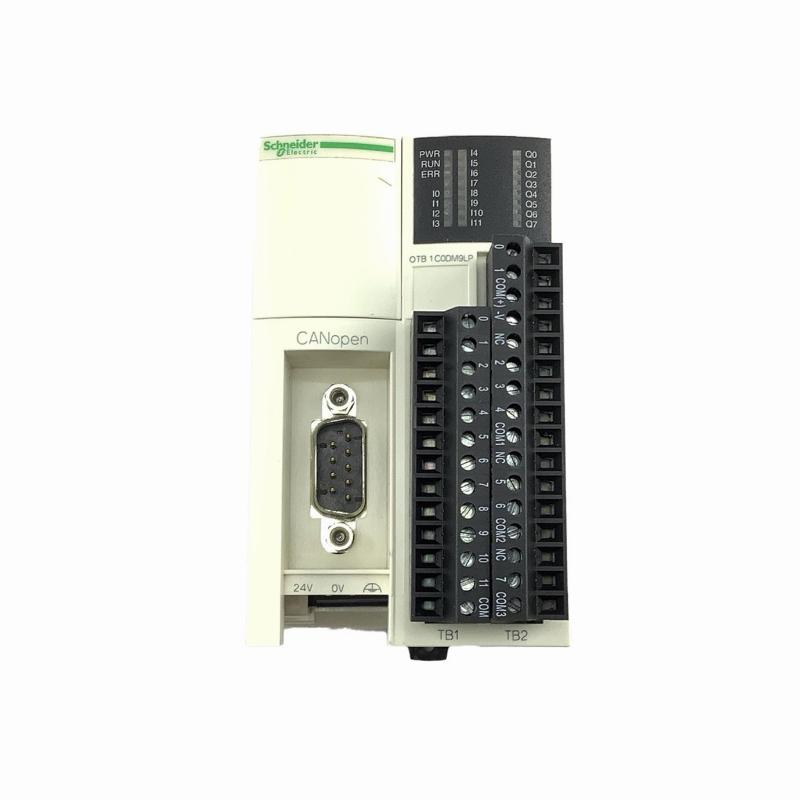
The Schneider Electric OTB1C0DM9LP I/O Distributed Module is a rugged, field‑ready distributed I/O unit designed to bring digital input and output control directly to the machine level. Part of the Modicon Advantys OTB family, this module combines reliable I/O interfacing with CANopen fieldbus communication, helping industrial systems achieve modular, low‑latency connectivity between sensors, actuators, and higher‑level controllers.
Engineered for reduced wiring complexity and faster installation, the OTB1C0DM9LP supports flexible machine layouts and decentralized architectures. Its compact form, robust digital interfaces, and fieldbus compliance make it ideal for automation systems requiring dependable distributed I/O performance with minimal footprint.
Technical Specifications
| Specification | Details |
|---|
| Manufacturer | Schneider Electric |
| Model Number | OTB1C0DM9LP |
| Module Type | I/O Distributed Module |
| Product Family | Modicon Advantys OTB |
| Communication Protocol | CANopen Fieldbus |
| Data Rate | 10 kbit/s – 1 Mbit/s |
| Maximum Bus Length | Up to 1000 m (varies with baud rate) |
| Discrete Inputs | 12 Digital Inputs (24 V DC) |
| Discrete Outputs | 8 Outputs (6 Relay + 2 PNP Solid‑State) |
| Input Voltage | 24 V DC |
| Output Voltage | 24 V DC (Solid‑State), up to 240 V AC / 30 V DC (Relay) |
| Power Supply | 24 V DC |
| Expansion Capability | Supports up to 7 TM2 I/O Expansion Modules |
| Protection Rating | IP20 |
| Mounting | DIN‑Rail |
| Indicator LEDs | Power, Run, Error, Channel Status |
| Operating Temperature | 0°C to 55°C |
Industrial Applications
Machine Automation Systems
Ideal for modular production lines, the OTB1C0DM9LP places I/O close to sensors and actuators, reducing long wiring runs and improving system responsiveness.
Packaging and Material Handling
In packaging plants, automated conveyors and handling devices benefit from local I/O distribution, ensuring rapid response and streamlined installation.
OEM Equipment Integration
Machine builders can integrate this module into OEM automation platforms to offer scalable, distributed control without complex wiring harnesses.
Distributed Control Architectures
In systems adopting decentralized automation, this unit enables reliable communications to PLCs, motion controllers, and safety systems over CANopen.
Key Advantages
Distributed I/O With Fieldbus Integration
Combines digital inputs and outputs with CANopen communication, simplifying network design and enhancing system modularity.
Reduced Wiring and Installation Time
Deploying I/O modules near field devices cuts down on long cable runs, control panel complexity, and installation costs.
Expandable Architecture
Supports additional TM2 expansion modules, enabling flexible system growth without redesigning the control system.
Robust Industrial Construction
IP20 protection and status indication LEDs ensure reliable operation and easy diagnostics in industrial environments.
Flexible Mounting
Standard DIN‑rail installation allows seamless integration into control cabinets and machine frames.
Technical FAQs
1. What type of communication does the OTB1C0DM9LP use?
It uses the CANopen fieldbus protocol for reliable industrial communication.
2. How many discrete inputs and outputs are available?
The module includes 12 digital inputs and 8 digital outputs.
3. What type of outputs does this module provide?
It includes 6 relay outputs and 2 PNP solid‑state outputs.
4. What power supply voltage is required?
The module operates on a 24 V DC power supply.
5. Can expansion modules be connected?
Yes—up to seven TM2 I/O expansion modules can be added.
6. What protection level does the module have?
It is rated IP20 for panel‑mounted industrial use.
7. What is the maximum fieldbus distance supported?
CANopen bus length can reach up to 1000 m, depending on network speed.
8. How are device statuses indicated?
LEDs provide visual indicators for power, run, error, and individual channel status.
9. Where is this module typically mounted?
It is mounted on standard DIN‑rail inside control cabinets or machine frames.
10. In what systems is it commonly used?
Commonly used in machine automation, material handling, OEM equipment, and distributed control systems.
 A DCS Q Co., Ltd. - PLC and DCS Industrial Control Equipment Wholesale