Product Introduction
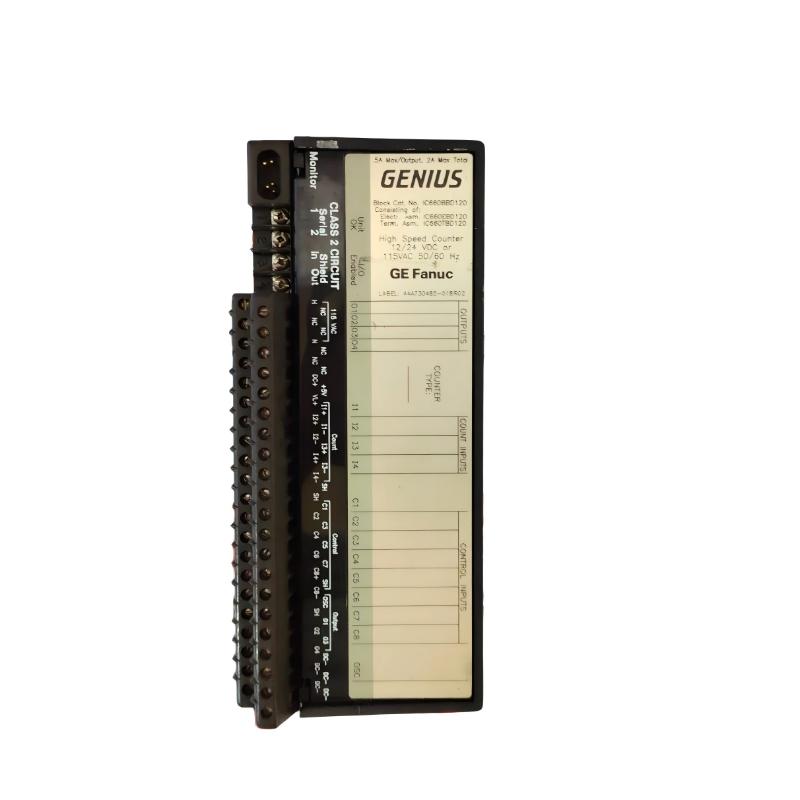
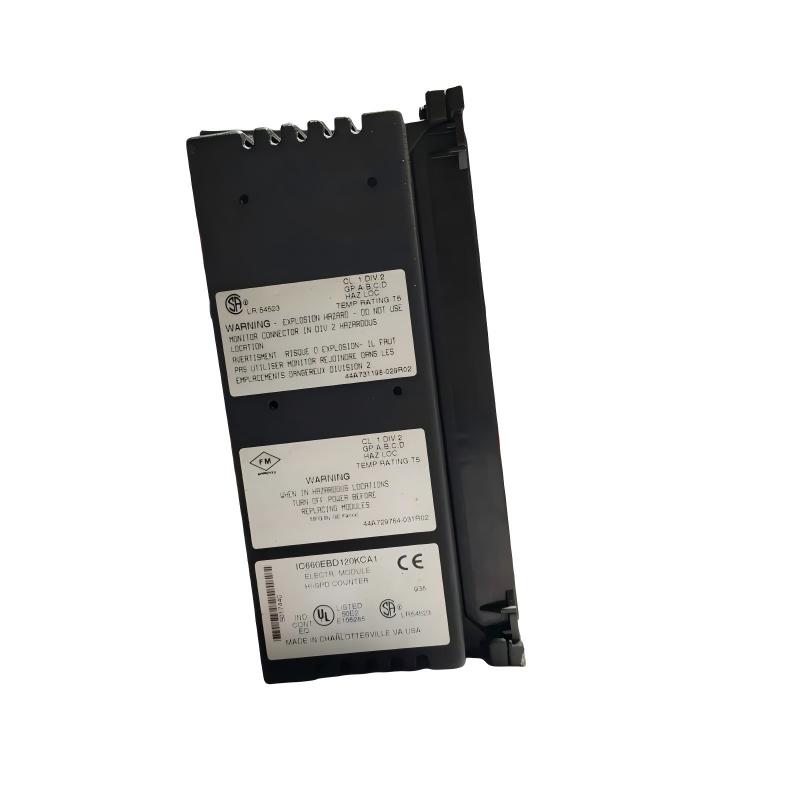
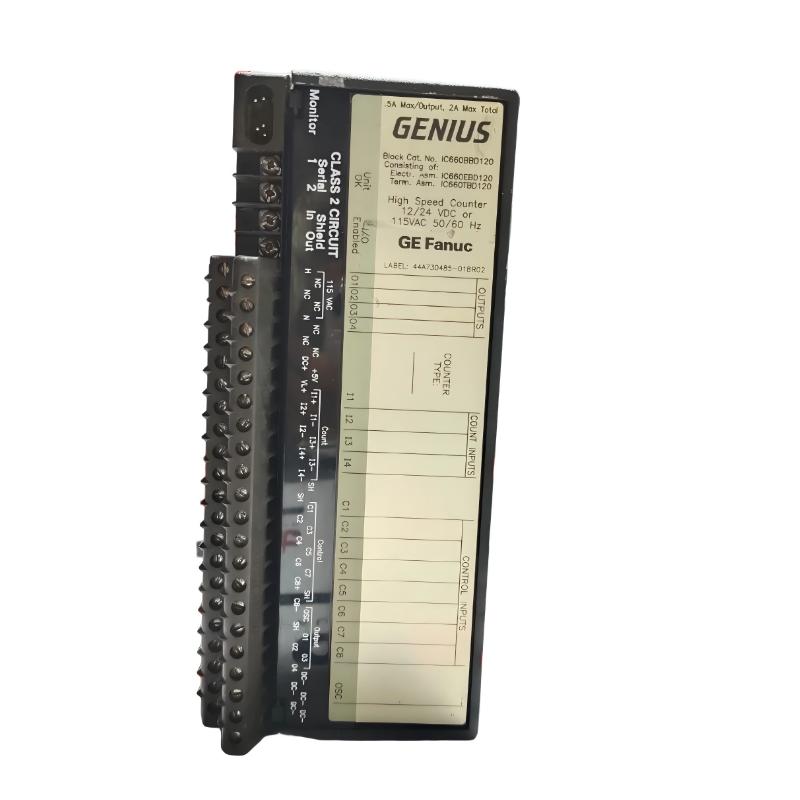
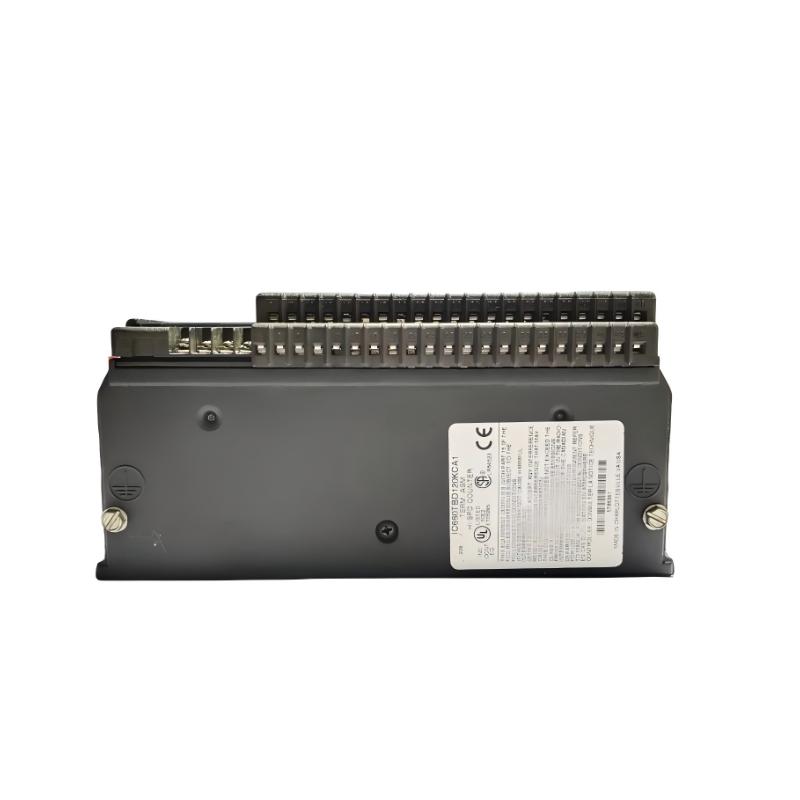
The GE Fanuc IC660BBD120 High-Speed Counting Block is a specialized distributed I/O module engineered for applications requiring rapid pulse counting and precise event detection. It forms part of the Genius I/O system and integrates with GE Fanuc PLC platforms such as Series 90 automation controllers.
By supporting multiple counter configurations and high-frequency signal processing, the module enables accurate monitoring of motion-related data in industrial systems. It processes counting operations locally and transmits results through the Genius network, improving overall control system efficiency.
Because of its high-speed processing capability and integrated diagnostics, the IC660BBD120 is widely used in motion monitoring, speed measurement, and pulse-based instrumentation systems across manufacturing, energy, and process industries.
Technical Specifications
| Parameter | Specification |
|---|
| Manufacturer | GE Fanuc |
| Model | IC660BBD120 |
| Module Type | High-Speed Counting Block |
| Series | Genius I/O |
| Number of Counters | 1 / 2 / 4 configurable |
| Number of Inputs | 12 discrete inputs |
| Input Voltage Range | 5 VDC – 30 VDC |
| Maximum Counting Frequency | 200 kHz |
| Minimum Pulse Width | 2.5 µs (high-frequency mode) |
| Input Response Time | 0.5 ms + configurable filter |
| Outputs | 4 discrete outputs + oscillator output + 5 VDC output |
| Output Voltage | 4.75 – 5.25 VDC |
| Output Current | 0.5 A |
| Communication Protocol | Genius I/O Bus |
| Operating Temperature | 0°C to 60°C |
| Storage Temperature | −40°C to 100°C |
| Dimensions | 224.4 × 88.9 × 100 mm |
| Weight | 1.8 kg (3.97 lb) |
Industrial Motion & Pulse Monitoring Applications
The GE Fanuc IC660BBD120 High-Speed Counting Block is a specialized Genius I/O module designed for high-frequency pulse detection and event counting in industrial automation systems. Unlike standard discrete I/O modules, this block is optimized for applications where precise timing, position tracking, or high-speed pulse processing is required.
It is commonly deployed in control systems where mechanical motion or rapid signal changes must be accurately monitored, such as:
-
Encoder-based position measurement systems
-
Conveyor speed and rotation monitoring
-
Flow measurement systems using pulse output sensors
-
Packaging machinery cycle counting
-
Turbine and motor speed feedback monitoring
-
Automated production equipment with high-frequency sensors
The module processes incoming pulse signals locally and communicates results through the Genius network, reducing CPU load and improving system responsiveness.
Operational Advantages for High-Speed Automation
High-Frequency Counting Capability
The module supports counting rates up to 200 kHz when using the high-frequency filter mode, enabling accurate tracking of fast pulse signals from encoders or sensors.
Flexible Counter Configuration
It can be configured to operate as 1, 2, or 4 independent counters, allowing engineers to adapt the module to different control architectures.
Integrated Input Processing
The module contains 12 discrete input channels, enabling multiple high-speed signals to be monitored simultaneously.
Built-in Output Control Functions
Four discrete outputs and a dedicated oscillator output allow the module to trigger actions when preset count thresholds are reached.
Local Processing for Faster Response
The block can process counting tasks independently without continuous CPU interaction, which improves performance in high-speed applications.
Technical FAQs
1. What is the maximum counting frequency supported by the IC660BBD120?
The module supports counting frequencies up to 200 kHz with the high-frequency input filter enabled.
2. How many counters can be configured in the module?
It supports 1, 2, or 4 configurable high-speed counters, depending on system configuration.
3. How many digital inputs are available?
The module includes 12 discrete input channels for high-speed signal acquisition.
4. What is the minimum pulse width that can be detected?
With the high-frequency filter selected, the module can detect pulses as short as 2.5 µs.
5. What is the input response time?
Typical input response time is 0.5 ms plus configurable filter delays.
6. What output channels are available?
The module includes four discrete outputs, one oscillator output, and one 5 VDC auxiliary output.
7. What voltage range is supported for input signals?
Input signals can operate within a 5 VDC to 30 VDC range.
8. Does the module support programmable filtering?
Yes, selectable filter modes allow operation for either high-frequency pulse counting or lower-frequency signals.
9. What communication network does the module use?
It communicates through the Genius distributed I/O protocol used in GE Fanuc automation systems.
10. What types of sensors are typically used with this module?
Common inputs include incremental encoders, proximity sensors, optical sensors, and pulse-output flow meters.
 A DCS Q Co., Ltd. - PLC and DCS Industrial Control Equipment Wholesale