Industrial Integration Environments
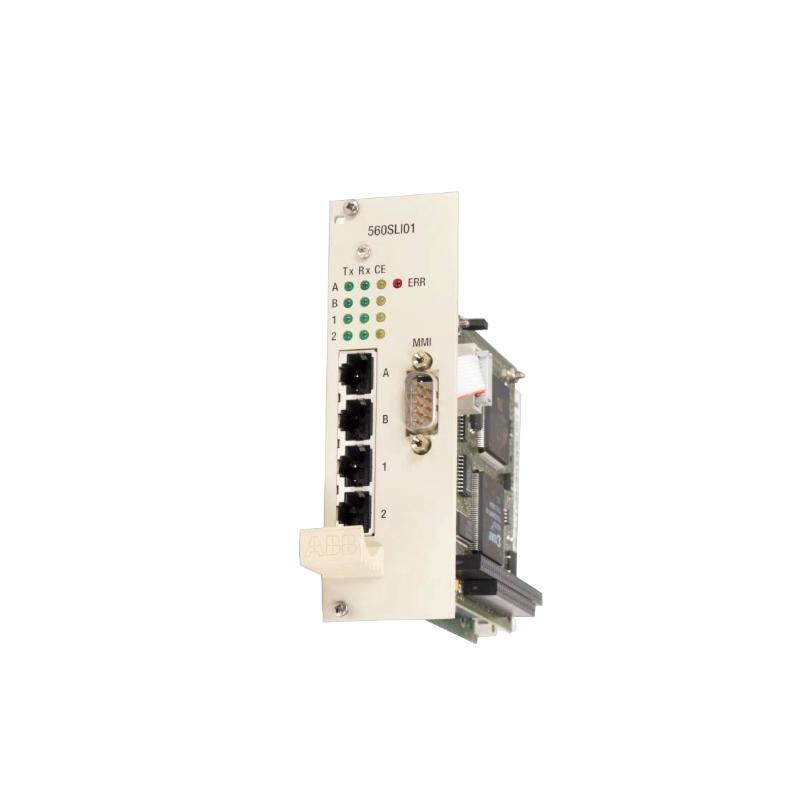
The ABB 560SLI01 Serial Line Interface Unit is designed to enable stable serial communication between automation controllers and external field devices. In industrial automation infrastructures where legacy equipment, instrumentation networks, or serial communication protocols are still widely used, this interface module acts as a reliable bridge between devices and centralized control systems.
Typical use environments include:
-
Power generation facilities integrating turbine monitoring equipment
-
Process industries such as oil refining and chemical production
-
Industrial control systems requiring serial communication with legacy PLCs
-
Water treatment facilities connecting analyzers and monitoring instruments
-
Factory automation systems requiring stable communication with serial sensors and drives
The module enables controllers to exchange data with field equipment using serial communication standards, supporting long-term system interoperability.
Operational Advantages for Automation Engineers
Reliable Serial Communication Architecture
The module provides a stable interface for serial data transmission, ensuring dependable communication between controllers and peripheral equipment.
Compatibility with Legacy Systems
Many industrial plants still operate devices that rely on serial protocols. This interface unit allows modern control systems to integrate such equipment without replacing existing infrastructure.
Industrial-Grade Communication Stability
The design includes signal conditioning and electrical isolation features that help maintain consistent communication even in electrically noisy environments.
Flexible System Integration
The module can be deployed within larger ABB automation platforms, allowing system architects to extend connectivity to various field devices.
Simplified Maintenance and Diagnostics
Built-in status indicators and diagnostic features allow engineers to monitor communication health and quickly identify connection issues.
Technical FAQs
1. What is the main function of the 560SLI01 interface unit?
The module provides serial communication connectivity between ABB controllers and external devices such as sensors, analyzers, or legacy control equipment.
2. Which types of serial communication protocols are typically supported?
The module is commonly used with standard industrial serial protocols that operate through RS-based communication systems.
3. Can the interface unit communicate with multiple field devices?
Depending on the system configuration, the module can manage communication channels that allow interaction with multiple devices through serial connections.
4. How does the module ensure reliable communication in industrial environments?
It incorporates electrical isolation and signal stabilization mechanisms to reduce the effects of electromagnetic interference.
5. Is the module suitable for integrating legacy industrial equipment?
Yes. It is frequently used to connect older serial-based devices to modern automation systems.
6. How is configuration typically performed?
Configuration is usually handled through the automation system engineering software used for the ABB control platform.
7. What diagnostic features are available for communication monitoring?
Engineers can monitor link status, transmission errors, and communication activity through system diagnostics and module indicators.
8. Can the module operate in distributed control architectures?
Yes. It can be integrated into distributed automation systems where communication with remote serial devices is required.
9. What happens if communication is interrupted?
The controller can detect the interruption and trigger alarms, fault handling routines, or fallback operational logic.
10. Does the module support continuous data exchange with instrumentation devices?
Yes. It is designed to support consistent data transfer for monitoring and control applications that rely on serial communication.
 A DCS Q Co., Ltd. - PLC and DCS Industrial Control Equipment Wholesale