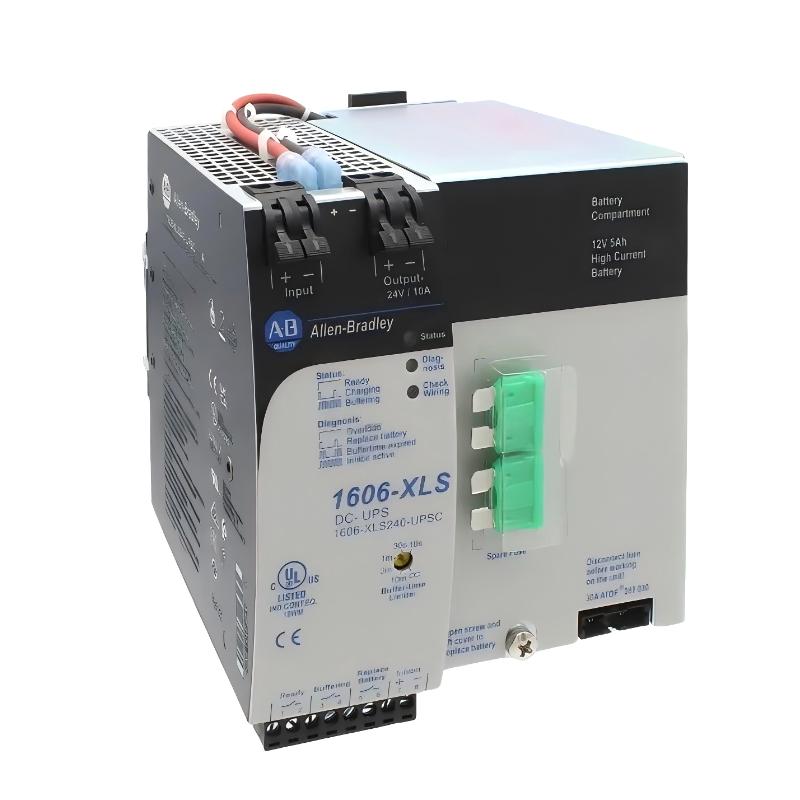
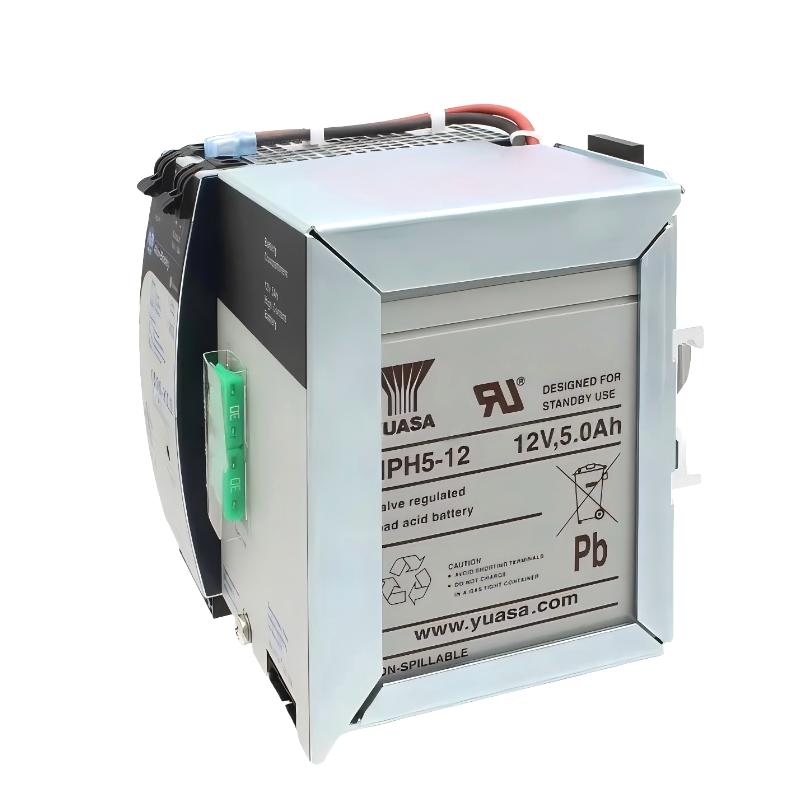
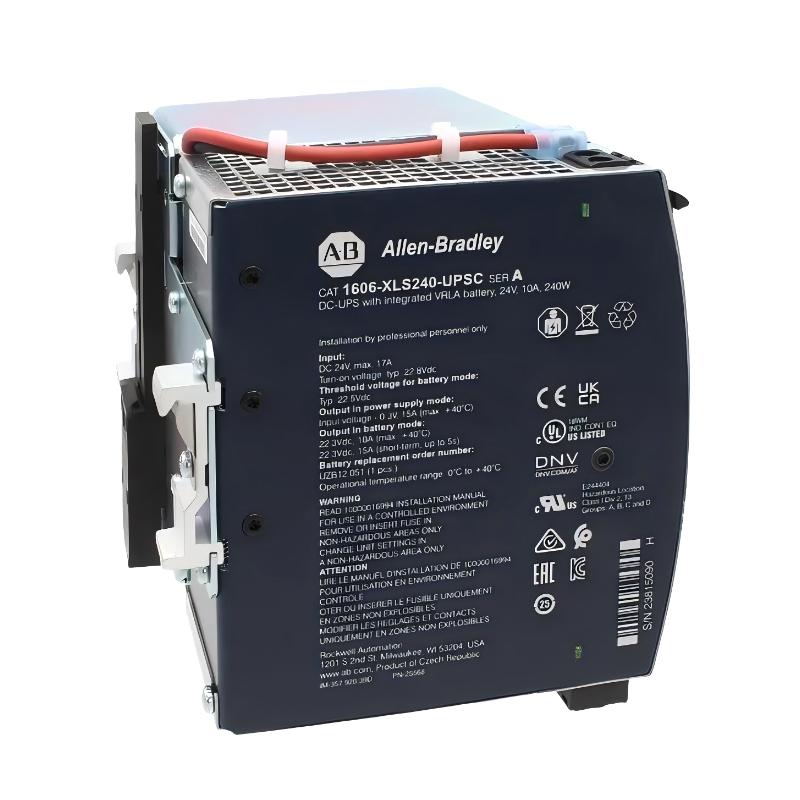
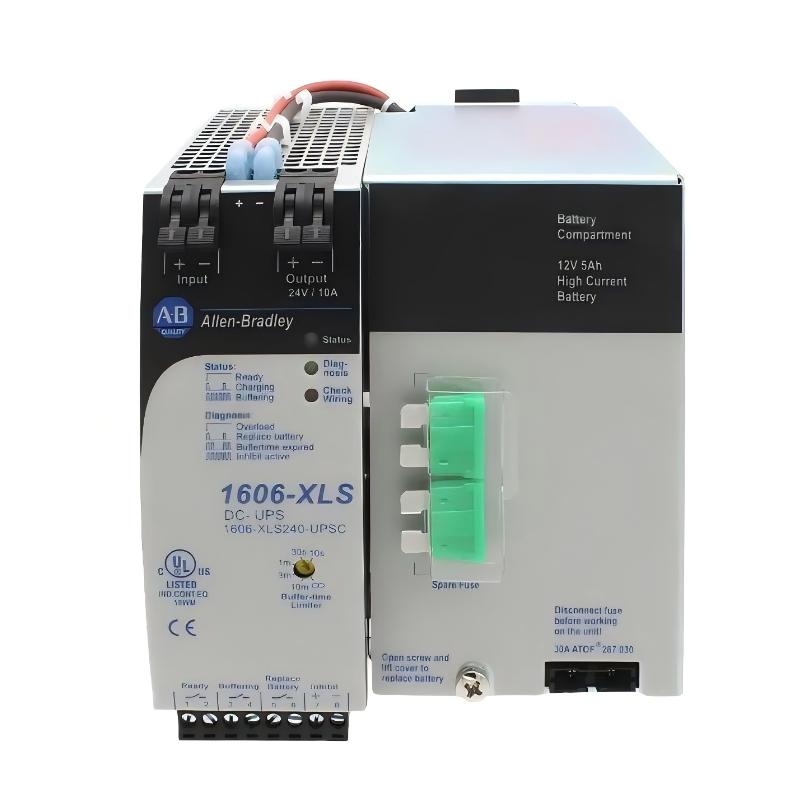
Product Introduction
The Allen Bradley 1606-XLS240-UPSC Power Supply Module is an industrial power management component designed to provide reliable DC power while supporting backup energy integration. In automation systems, stable power delivery is critical for maintaining communication between controllers, field devices, and monitoring equipment.
This module is engineered to operate within UPS-enabled DC power architectures. When primary input power is interrupted, the system can transition to a connected backup power source, allowing control equipment to remain operational until normal power conditions are restored.
Its design supports installation within industrial control cabinets and machine panels, making it suitable for manufacturing plants, processing facilities, and infrastructure systems where power continuity is critical for maintaining automation reliability.
Technical Specifications
| Parameter | Specification |
|---|
| Manufacturer | Allen Bradley |
| Model | 1606-XLS240-UPSC |
| Module Type | Power Supply Module |
| Application | Industrial automation power and backup power systems |
| Installation | Control cabinet / industrial panel |
| Function | DC power supply with UPS control capability |
| Dimensions | 124 mm × 119 mm × 123 mm |
| Weight | 2.85 kg (6.28 lb) |
Automation Infrastructure Deployment
The Allen Bradley 1606-XLS240-UPSC Power Supply Module is designed to deliver regulated DC power with integrated backup control capabilities for industrial automation systems. As part of the Bulletin 1606 series, this module supports reliable power distribution while also functioning within a DC uninterruptible power supply (UPS) architecture.
In automation environments, maintaining power continuity is essential to prevent system shutdowns, data loss, or process disruptions. The 1606-XLS240-UPSC module helps ensure continuous power delivery by managing both the primary DC output and the backup energy source interface. This design allows critical control equipment to remain operational during temporary power interruptions.
Typical industrial applications include:
-
Manufacturing automation systems, where PLC controllers and distributed I/O modules require uninterrupted operation.
-
Process control environments, including chemical and petrochemical plants where control stability is essential.
-
Material handling and logistics systems, where automation equipment must remain active to avoid operational downtime.
-
Power and utility infrastructure, where monitoring and control equipment must maintain continuous availability.
-
Industrial control cabinets, where UPS-enabled power modules protect sensitive automation hardware.
By combining regulated DC power output with backup power management, the module strengthens the reliability of industrial automation infrastructure.
System Advantages
Integrated UPS Power Management
The module supports connection to backup energy sources, allowing continuous power delivery during primary supply interruptions.
Stable DC Output for Control Systems
Regulated output voltage ensures consistent operation of PLCs, sensors, and communication devices.
Rapid Power Source Transition
The module can quickly switch between main power input and backup energy storage when required.
Industrial-Grade Construction
Designed for continuous use in automation cabinets and industrial environments.
Scalable Power Architecture
Multiple modules can be incorporated within control panels to support expanding automation systems.
Technical FAQs
1. What is the main purpose of the 1606-XLS240-UPSC module?
It provides regulated DC power while managing backup energy sources within an industrial UPS architecture.
2. What systems typically require this type of power supply?
Industrial automation systems that must remain operational during short power interruptions.
3. How does the module support uninterrupted system operation?
It manages the transition between primary power and backup power sources.
4. Can this module power PLC-based automation systems?
Yes. It provides stable DC power suitable for PLC processors and I/O modules.
5. Is the module suitable for installation in control cabinets?
Yes. It is designed for industrial cabinet installations.
6. What types of equipment can be powered by this module?
Controllers, sensors, industrial communication devices, and operator interfaces.
7. Does the module contribute to system reliability?
Yes. It helps prevent system shutdowns during temporary power loss.
8. Can the module be used in distributed automation systems?
Yes. It supports power distribution within large automation architectures.
9. Is it suitable for infrastructure and utility facilities?
Yes. It is commonly used where continuous monitoring and control are essential.
10. What role does the module play in control system architecture?
It acts as both a power conversion unit and a backup power management interface.
 A DCS Q Co., Ltd. - PLC and DCS Industrial Control Equipment Wholesale